Earlier this month I closed out my corporate career. If you’ve ever wondered what the week after looks like, this is it.

This morning I’m on a trail in Arizona’s Superstition Mountains before sunrise. The path is still in shadow as I climb. The only sounds are quail rustling through the underbrush and the soft song of the wind. For two decades, my mornings belonged to a calendar. This one belongs to the mountain.
I'm fully present. My eyes take in every color, my ears every scurry in the brush. I can feel my heart beating as I hold my stride, each breath full and deep. I feel lighter than I have in months, maybe years. No instant messages are waiting and no emails are humming in my pocket. Nobody needs anything from me. It's just me, the mountain, and an audience of One, and I'm savoring every step for its own sake.
As I crest the first small hill, the sky shifts from deep blue to cream and gold at the horizon. Then, in the blink of an eye, the sun peeks over the saddle of the mountain and lights up the trunk of a saguaro that was likely standing here when wagon trains and gold prospectors crossed this corner of the Southwest. A new day has dawned, and it feels like mine.
For most of my career, I wouldn’t have believed this morning was possible at 52. “Early retirement” meant my early 60s. Two things changed my mind.
The first was watching people I love. My father-in-law retired in his early 60s and passed away at 66, after two battles with cancer. He and my mother-in-law had fewer retirement years together than anyone expected, and afterward she didn't want to travel alone. My own parents lived into their 80s, and my mom into her 90s, but their worlds grew smaller as their mobility faded. I came to see that healthspan matters more than lifespan. Healthspan is the stretch of years when you still have the energy, health, and mobility to do what you love, and it's shorter than we tend to assume.
The second was my own life. After a long season of imbalance, I spent the last few years putting my health first: lifting weights, eating better, protecting my sleep, and making memories with my family. As I did, I wanted more of my time to go toward meaning and work on my own terms.
So I set a date: April 2027. Then the harvest came a few months early, when my role was eliminated in a reorganization. For months I'd been praying and preparing for a new season, so when the news came I felt more peace than shock. I'll admit a layoff is a quieter ending than a retirement. The send-off is smaller, and people care but don't quite know what to say. For my part, I left grateful for thirteen good years, for work I enjoyed, and for the great people I worked alongside. Because the plan was already built, what could have been a frightening change became an early start on the life we'd been planning.
As it turns out, my story isn't unusual.
Why the Harvest Often Comes Early
When we're building our careers, our families, and our lives, retirement is mostly a number in the back of our minds. For many of us that number is 65, when Medicare begins, or 67, when we reach full retirement age for Social Security. Reality tends to arrive sooner. In the Employee Benefit Research Institute’s 2026 Retirement Confidence Survey, nearly half of retirees said they left work earlier than they’d planned. Workers expect to retire at a median age of 65, while retirees report leaving at a median age of 62, three years before Medicare begins and, for many of us, five years before full retirement age. Some leave because they’re ready. Many leave because something outside their control makes the decision for them.
Allianz Life's 2026 Annual Retirement Study asked people who retired earlier than planned why they left. These were the top three answers.
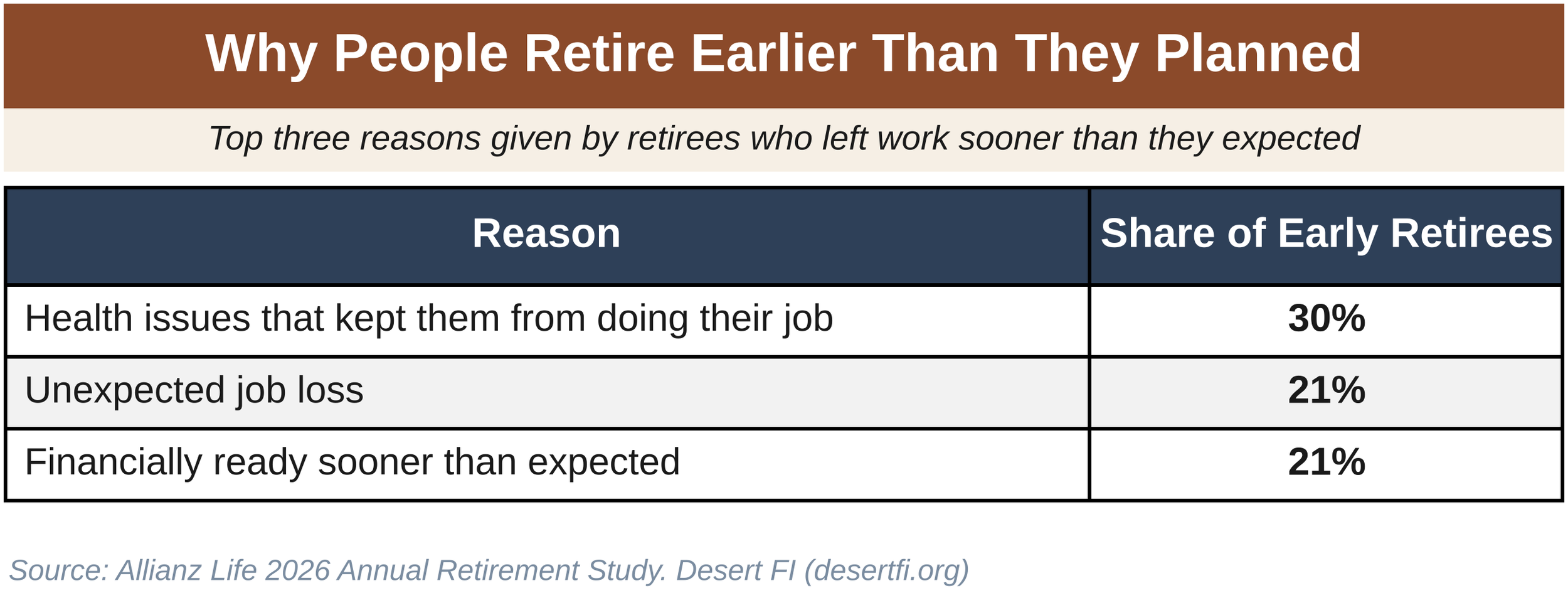
The pressure starts earlier than we think. A ProPublica and Urban Institute analysis of the federal Health and Retirement Study found that 56% of workers over 50 were laid off at least once or left a job under circumstances that suggest they were pushed out. Only about 1 in 10 of them ever earned as much again. Caring for an aging parent or a spouse pulls others out early too.
The good news is that this risk is predictable, which means you can prepare for it. Here are the five steps that made the difference for me. If your exit is ten or twenty years away, they still apply, and you have the advantage of time.
1. Know Your Number
Every plan starts with two numbers: what you spend and what you'll need. If you don't track your spending, start there. It's the foundation for everything else.
Tracking is easier than it used to be. Apps like YNAB, EveryDollar, and Monarch do most of the heavy lifting. If you prefer a spreadsheet, download a year of transactions from your bank and card accounts and group them into a handful of categories, by hand or with help from an AI assistant (leave out account numbers).
The classic financial independence target is about 25 times your annual spending. It comes from the 4% rule, the research finding that a balanced portfolio has historically supported withdrawals of about 4% in the first year, adjusted for inflation each year after, for at least 30 years. If your household spends $80,000 a year, your FI number is roughly $2 million.
Now run the math the other way. A million dollars sounds like a finish line, but at 4% it supports about $40,000 a year before taxes. That assumes the full million is invested. Home equity doesn’t count, because you still need a place to live.
Look at what drives that number. It took me years to see it. As a spreadsheet nerd, I used to love running future value calculations: if we invest this much and earn that return, what will we have at 62, 65, or 67? Those numbers helped me balance saving for later with making memories while our son was still at home, but my eyes were on the size of the portfolio. Over time I came to understand that spending sets the target, because the number you need is a multiple of what you spend. For the last seven or eight years, our planning has centered on understanding and adjusting our spending, shrinking big variables like housing, and matching our savings rate to the plan. Saving more helps twice. Every dollar you save grows the portfolio, and a household that lives on less needs a smaller portfolio to stop working. That's when I started asking a different question. What would have to be true for us to downshift at 58, or 55, or, gasp, even 52?
Part of the answer is that the number can come down. Bill Bengen, the researcher behind the 4% rule, has since raised his figure to about 4.7%, a change I cover along with the spending guardrails I use in The Sequence That Determines Whether Your Retirement Lasts. At that rate, the same $1 million supports about $47,000 a year. Add a few years of cash and bonds to ride out a downturn, plus even modest part-time income, and the math shifts again. The Harder Trail shows what happens when a Next Endeavor covers half your spending. A willingness to adjust and a little income from work you enjoy can move your date years earlier. They moved mine.
Once you have your number, write it down. Schwab's 2024 Modern Wealth Survey found that only 36% of Americans have a written financial plan, and three in four of those who do say it makes them feel more in control of their finances. A written plan tells you where you stand today, what you need, and which levers move the date: eliminating consumer and car debt, downsizing if it makes sense, and getting your home paid off or within five years of it by the time you stop working.
You can build your plan in a spreadsheet, use a planning tool like Boldin, or hire a fee-only, advice-only planner who charges for advice rather than a percentage of your assets. If your advisor charges an assets under management (AUM) fee, know what it costs you. Planning researcher Michael Kitces found that a 1% fee lowers a 4% safe withdrawal rate to about 3.6%, roughly a tenth of your retirement spending every year. Good advice is worth paying for, and it's worth knowing the price.
If you want a place to start, I walk through the milestones in Your Financial Road Map and the budget questions in 7 Questions to Ask in Building Your Downshift or Retirement Budget.
2. Build Your Bridge
Your number tells you whether you can retire. Your bridge determines whether an early exit is a speed bump or a cliff.
I learned this the hard way. The first time I was laid off was during the Great Recession, a year out of business school. I took a job as a commercial real estate broker at a time when survival was the new success. By that standard we succeeded, but barely. It was a stressful season. This time was completely different because the bridge was already built. We just crossed it a little earlier than planned.
A bridge is what carries you from your last paycheck to the point where your long-term plan takes over. It has four parts.
Cash. Start with 12 to 24 months of expenses in cash or short-term Treasuries. Measure it against what you spend, which is less than what you earn. That's your cushion if the job ends before you're ready, and it gives you time to regroup, look at options, and make decisions without pressure. As you get closer to a planned exit, build it toward three years or more. A key part of my own plan has been building a Treasury ladder in my last few years of working so that a bad market doesn’t force me to sell stocks at a loss, an approach I explain in detail in Landing the Plane, Part 1.
No consumer debt. Car payments and credit card balances weigh on a budget even when the paychecks are coming in. When the paychecks stop, those payments raise your withdrawal rate and the size of the portfolio you need to downshift or retire. Get them to zero while you're still earning.
Health coverage. Your employer likely pays a good share of your health insurance today, and that subsidy ends when the job does. Many people keep working until 65 because they've heard health insurance is expensive and they've never dug into the numbers. Do the digging. Say coverage costs $1,500 a month, or $18,000 a year. That's a real expense, but it's a number you can estimate now, build into your post-work budget, and cover. Whether it's COBRA, the ACA marketplace, or a spouse's plan, health insurance doesn't have to stand between you and the life you're dreaming about.
Protection while you work. Keep your disability coverage and capture every benefit your employer offers while you're there. I covered how in Don't Leave It in the Field.
One more piece belongs here. A forced exit can tempt you to claim Social Security at 62. If your full retirement age is 67, claiming at 62 permanently reduces your monthly benefit by 30%. A good bridge gives you the option to wait. I wrote about timing your exit, health insurance, and the final working year in Landing the Plane, Part 2.
3. Plan to Taper, Not Stop
Most retirement planning assumes a hard stop: full-time work one day, nothing the next. There's another path.
Regular readers know I've spent much of the past year building out FINE, which stands for Financial Independence, Next Endeavor. If you're new here, the idea is simple. Once you reach financial independence, or get close, you keep working, but on your own terms: fewer hours, more flexibility, and work you'd choose even if you didn't need the money. That might be consulting, coaching, teaching, writing, or a passion project that pays something.
FINE also answers the objection I hear more than any other: "I'd love to travel, spend more time with my spouse and kids, and pursue my hobbies, but what would I do with the rest of my time?" It's a fair question. Work is a good thing, and done in balance it's deeply fulfilling. A Next Endeavor keeps structure in your days while giving you the freedom to take days, weeks, or even months off for the life you want. You pick the work and the people you do it with, and you turn it up or down as you choose.
The money matters more than you might think. Even modest Next Endeavor income dramatically reduces how much you need to save. A $20,000 annual income stream covers the same spending as roughly $500,000 in savings at a 4% withdrawal rate. I walked through the full math in Why $20K a Year Changes the Retirement Math More Than You Think.
The bigger payoff is purpose. A Next Endeavor brings the joy of serving others, using the gifts you've spent decades developing, and keeping your mind engaged while you still earn an income. How FI Led Me to FINE explains where the idea came from, and How to Find Your Next Endeavor is a practical place to start. If you're wondering whether you're there yet, The Seven Signs You're Ready for a Next Endeavor will help you tell.
There's one more reason to taper. It protects you against the biggest risk in early retirement.
4. Respect the Sequence
The order of your investment returns can matter more than the average.
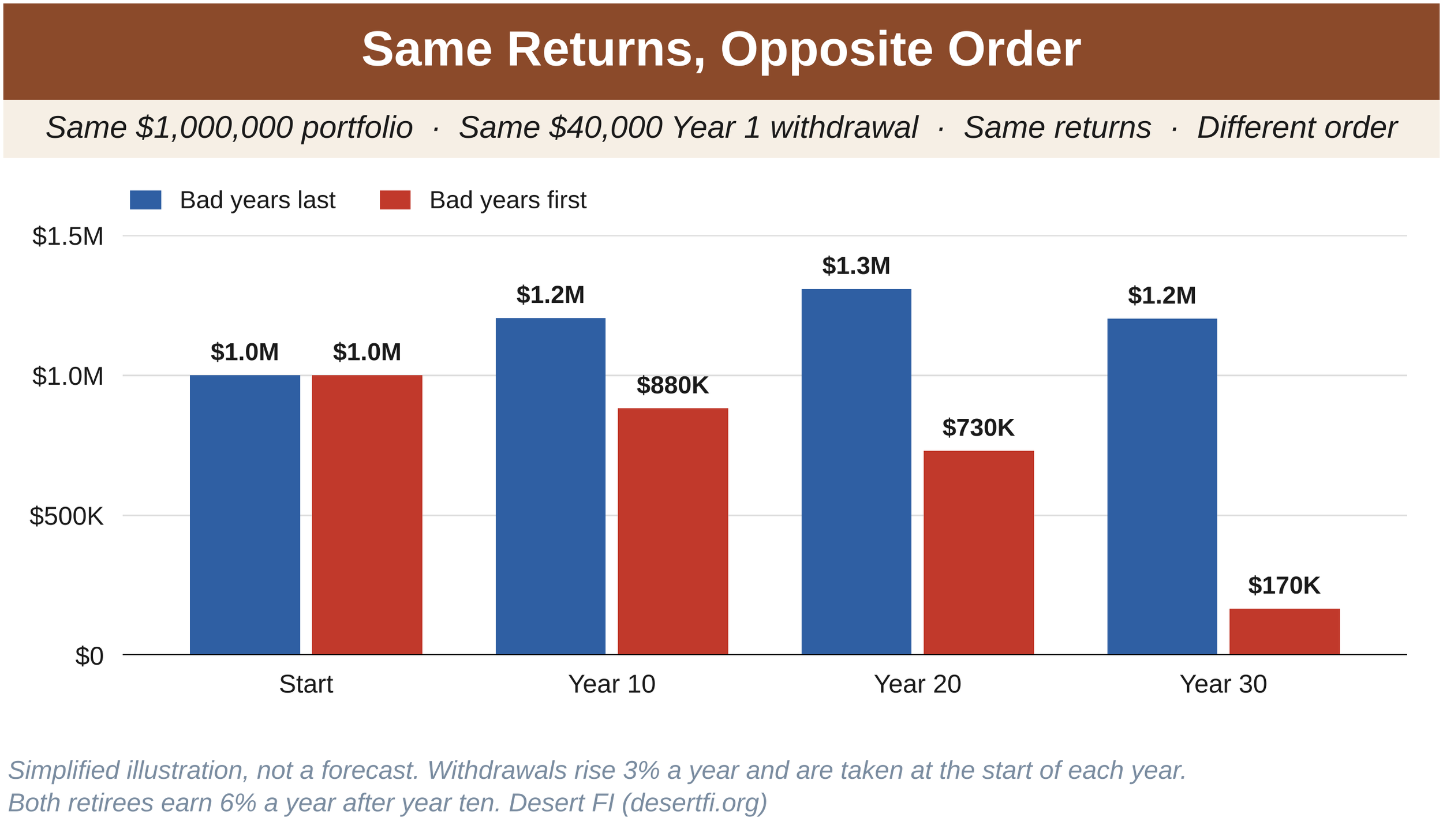
Here's a simplified example. Two retirees each start with $1 million and withdraw $40,000 in the first year, raising it 3% a year for inflation. Over their first ten years, they earn exactly the same returns, averaging 6% a year, but in opposite order. One hits two bad years at the start, down 20% and then 10%. The other gets those same bad years at the end. After that, both earn 6% a year.
Ten years in, the first retiree has about $880,000. The second has about $1.2 million. Thirty years in, the second retiree still has about $1.2 million. The first is down to about $170,000.
That might not sound like a crisis until you remember that spending has grown 3% a year for three decades. The $40,000 withdrawal from year one has grown to more than $90,000 a year, so that $170,000 covers less than two years. If you retired at 55, you'd be 85, with a real chance of living into your 90s and almost nothing left to live on. Both retirees earned the same returns and took the same withdrawals. The difference is more than a million dollars, all from timing.
This is called sequence of returns risk, and it's why the first five to ten years of retirement matter most. Your bridge helps, because cash and bonds let you avoid selling in a downturn. Next Endeavor income helps even more, because every dollar you earn is a dollar you don't have to withdraw when markets are down. The numbers here are simplified on purpose. For the detailed math, real historical sequences, and the strategies I use, read The Sequence That Determines Whether Your Retirement Lasts.
5. Decide What Your Life Is For
The first four steps answer whether you can leave. This one answers what you’re leaving for.
Remember healthspan. A Mayo Clinic study published in JAMA Network Open found that Americans live an average of 12.4 years with disease or disability, the widest gap between lifespan and healthspan of the 183 countries studied. The good years are a gift, and they're limited. It’s a big reason I write Desert FI. After 40 or 50 years of work, I want people to reach their good years with time left to enjoy them.
Once the money question is settled, a harder one takes its place: what do you want your life to be about? Travel is wonderful, but there are only so many trips before you're ready to be home. What comes between the trips? What brings you joy on a random Tuesday morning? Who will you spend those mornings with? These are the questions that shape a life well lived.
For me, some of the answers are already taking shape. My wife and I are training for a pilgrimage across the Scottish Highlands next summer, tracing the routes of early Celtic missionaries, with several days of 12- and 13-mile hikes. A good friend in his 50s retires at the end of the year, and we already have hiking and kayaking plans. Plans like these depend on the healthspan we still have.
Spend real time with these questions before you need the answers. Journal, talk with your spouse, and pray if you're a person of faith. Test the life you're planning before you leave, the way I did in The Weekday World I Never Saw. If you're not sure what kind of work would still give you life, The Four Types of Work, and the One Most People Never Reach is a good place to think it through.
Speed Bump, Not a Cliff
Earlier I mentioned that only about a third of Americans have a written financial plan. I suspect far fewer have spent real time on their purpose and calling. I believe many of us work longer than the math requires because we haven't prepared and because so much of our identity lives in our work.
Part of my mission is helping people ask the bigger questions and prepare for the unexpected, so that if work ends sooner than planned, it's a speed bump and not a cliff. With enough preparation, it can even be a harvest. Each of us has been given unique gifts, passions, and contributions to make, for the good of others and for our own delight.

The Trail Ahead
Near the top of that climb in the Superstitions, I scrambled onto a boulder, sat back, and let the light wash over the peaks. I thanked God for the trail behind me and for the quiet of the morning. Then I looked at the trail ahead, full of color, with more paths to explore than I'll ever finish. Until my legs give out, I plan to keep chasing adventure, serving others, spending time with my family, and enjoying the most precious gift of all: time.
One step this week: Add up what your household spent over the last twelve months and multiply it by 25. That's your starting number.
Two questions before you go:
If financial independence is new to you: if your paycheck stopped this year, what would you most wish you already had in place?
If you've been on the trail for a while: which of these five steps have you been putting off, and what would it take to finish it?
This month's series is The Harvest. If you missed the first two posts, start with Don't Leave It in the Field and The Joy of Giving.
The trail is better with good company.
🌵 Bill Robinson, Desert FI
Want to go deeper?
Desert FI Insiders get Weekend Reflections every Sunday morning, plus free resources like the Well-Timed Exit Checklist and the FINE Number Calculator to help you work through the five steps above. If you're not on the trail with us yet, join at DesertFI.org/join
Already an Insider? Here are three posts worth exploring:
The 10-Year Window Most People Miss, on why the years between 45 and 55 are the most leveraged decade of your life
Five Financial Decisions That Made My Downshift Possible, on the money choices that built the margin
The Noises in the Night: Five Retirement Worries That May Wake You at 3 A.M., on five worries about leaving a paycheck and one step for each
Sources cited in this post
Employee Benefit Research Institute and Greenwald Research, 2026 Retirement Confidence Survey
Allianz Life, 2026 Annual Retirement Study
ProPublica and the Urban Institute, If You're Over 50, Chances Are the Decision to Leave a Job Won't be Yours (December 2018)
Advisor Perspectives, Bill Bengen Boosts the "4% Rule" to 4.7% (August 2025)
Charles Schwab, 2024 Modern Wealth Survey
Michael Kitces, The Impact of Investment Costs on Safe Withdrawal Rates
Social Security Administration, Early or Late Retirement?
Garmany and Terzic, Global Healthspan-Lifespan Gaps Among 183 World Health Organization Member States, JAMA Network Open (December 2024)