Landing the Plane, Part 1: Building Your Drawdown Framework

I still remember the first time Arizona captivated me.
It was March, and I was flying out West to meet a client whose handshake would determine whether my family and I would uproot our lives and move across the country. The weather was warm and pleasant, about forty degrees warmer than the grey clouds and cold rain I'd left behind. After a good meeting and a strong sense that the promotion was coming, I drove alone through the Valley of the Sun, windows down, sunroof open, taking in sights I had no vocabulary for yet.
As I drove around, with fresh spring air flowing around me and tunes on the rental car stereo, I saw mountains visible in every direction with different colors and shapes defining them. Driving through neighborhoods where we might live someday, I saw rock landscaping in front yards called xeriscaping. Other neighborhoods had grass yards, palm trees, and natural grass sports fields. From time to time, saguaro cacti stood sentinel at neighborhood entrances. And as the sun dropped toward the horizon, the sky turned fiery colors I'd never seen on the East Coast: twenty shades of red, gold, amber, and purple, layered one on top of another, fading slowly into the desert twilight.
Afterwards, sitting outside under palm trees and bright stars, eating the best street tacos I'd ever tasted, I called my wife. We agreed: this felt like exactly the change and big open sky we needed in our lives.
What followed was a season of discovery that no amount of research had prepared us for. The joy of mild winters and extravagant springs. Spring Training baseball with throngs of fans filling stadiums for a more relaxed environment where they could interact with their favorite players. The Barrett-Jackson auction, the largest in the world, bringing car enthusiasts and rare, vintage, and concept cars from everywhere. The Phoenix Open and its hundred thousand fans descending on Scottsdale for a week of golf and celebration, with a festive, stadium-seating, Happy Gilmore atmosphere. The city vibrated with energy and yet a vacation vibe in ways that our growing Southeastern hometown never quite had. It fit us like a glove.
But we also had to learn the rules of a completely different environment. We learned that in the desert, hydration isn't optional, so like our neighbors we started carrying larger bottles and mugs everywhere. We noticed quickly that savvy residents drove white cars with front and back sunshades to keep interior temperatures cooler in the summer heat. We learned the names for more than a dozen types of cacti. After moving, our vocabulary for sunsets and cloud formations deepened because they inspired enough awe that we wanted to be able to describe them, since a picture never quite captured what we were seeing. We learned about Mediterranean plants, seasonal watering adjustments, monsoon season, dust storms, and a thousand other things that made our life richer and our understanding of our new environment deeper.
As I've shared before, even for lifelong East Coasters, moving to the Southwest became one of the best decisions of our life. But it required something specific: learning an entirely new set of rules. The instincts we'd spent decades developing in a different climate weren't wrong. They were calibrated for a different environment.
You may not live in the desert. You can probably still relate to that feeling of newness and adjustment from some season in your life. The transition from accumulation to distribution is exactly like that. This post is about building a new framework before you need it.
One important note: everything here reflects my own planning process and thinking. I share it for educational purposes, but each person's circumstances, objectives, risk tolerance, savings and spending levels, and other factors are unique. Please consult a fee-only CFP and CPA before making decisions about your own drawdown strategy.
Accelerating the Timeline
Until about three or four years ago, I fully expected to work into my early-to-mid sixties. I genuinely loved the work, had no particular urgency to leave, and frankly hadn't known many early retirees or downshifters. My investment strategy reflected that timeline. Don't judge me, but I was 100% US equities focused, with the exception of a checking account and a six to twelve month emergency fund. I traditionally held no bonds, no target-date funds, and no international exposure beyond the many US companies with global businesses and revenues. It's not the recommended approach, but I had a graduate level finance education, worked inside a large brand-name company, and followed the economy closely. With a decade-plus time horizon, I had a high risk tolerance and was comfortable riding the market's ups and downs. I knew from experience that I wouldn't panic during recessions or trade in and out of assets. I bought positions and held them for the long term.
Then came what I’ve written about elsewhere as the Minnesota moment, the season that changed how I saw the second half of life and set me on the path toward downshifting in my early fifties rather than my early sixties.
The financial plan I needed to build for that earlier timeline was fundamentally different from the one I'd been executing. And the instincts I'd spent thirty years developing would be, in many ways, exactly wrong for what came next.
Flying Upside Down
Imagine you are a pilot who has trained your entire career to fly an F-18. You are in combat, in close pursuit, locked onto your target. You are navigating every which way, executing everything your training taught you, completely absorbed in winning the engagement. In the heat of the moment, you don't notice that the horizon has inverted. You are flying upside down. And every time you pull the stick to correct your altitude, you are moving further in the wrong direction. Your training is precise. Your execution is flawless. You are flying directly toward the ground.
That's what accumulation instincts do in a distribution environment.
Maximize returns. Focus on long-term dollar cost averaging. Stay fully invested. These are the right instincts for thirty years of building wealth. In distribution, applied without modification, they become the instincts that hurt you most. The pilot doesn't crash because he or she is reckless. The crash happens because the training no longer applies to the environment.
This year I bought bonds for the first time in my adult investing life. I also purchased international equity funds for the first time, specifically to protect against a US-concentrated lost decade scenario similar to what investors experienced in the 1970s or the 2000s. I've had to shed old ways of thinking, expand my understanding of what diversification actually means, and deliberately trade maximum long-term returns for lower, steadier ones with less sharp peaks and valleys. Building greater liquidity and cash reserves went contrary to my accumulation instincts, but the research and the planning pointed clearly in that direction. I'm well prepared for a launch into a new phase of life.
It's been humbling. And it's been exactly right.

Enter Jack
Rebuilding the instrument panel required help I could trust.
I've been friends with “Jack” for more than thirty years. He's a CFP and we've always naturally talked about financial planning when we get together, the way other friends talk about sports or travel. While I'd been modeling savings, investment returns, and retirement dates for twenty-plus years, he helped me build my first written plan several years ago and has been a trusted sounding board ever since.
Earlier this year, after spending several months running Excel models with 10,000 bootstrapped Monte Carlo simulations, I hired Jack again on a fee-only project basis, frankly at a friendship rate. I wanted him to independently run the scenarios and guardrails I'd built using his professional software and expertise. My goal wasn't just validation. I wanted someone I trusted completely to tell me what I was missing, to suggest refinements, to help me optimize for taxes, and to ask me the questions I hadn't asked myself.
I asked him directly: what would keep you up at night about this plan if you were me? And: what do I do if the market drops 20% between now and my planned downshift date?
Those conversations produced several good refinements I'm currently implementing.
I'm a committed do-it-yourself investor and I plan to remain one. But having someone independently validate, critique, and pressure-test the plan and its assumptions before I execute it is worth every dollar of the fee. For my wife to hear from someone with no financial stake in the outcome that the plan is viable with a high probability of success, that alone was worth it. It also gives her a relationship with a trusted advisor should I pass away early and she needs someone not just to build the plan but to fly the plane.
If you have a Jack in your life, use him. If you don't, a fee-only CFP hired on a project basis for a one-time plan review is one of the highest-return investments you can make in the final years before your transition.
Quick Overview of the Plan
Before going deep on the specifics, a quick overview of the plan and its mechanisms will help orient the rest of the post.
My retirement plan involves a 70/30 mix of equities and fixed income. Within the 70% equity portion, my goal is approximately 67% US equities and 33% international exposure, all through low-cost mutual funds and ETFs. Within the 30% fixed income portion, there's a mix of cash and cash equivalents, a short-term US Treasury mutual fund, and individual bonds. I'll explain that breakdown in detail in the next section.
From a structural standpoint, we have a 401K, Roth and Traditional IRAs, a Health Savings Account, and taxable brokerage accounts in addition to our normal checking and savings accounts. I share that to help orient the deeper dive that follows, not to boast.
Bonds and SORR: Why Five Years
With that structure in mind, here's how I thought about sizing the cash, Treasury fund, and bond portion of our retirement savings.
My target for buckets one and two combined is five years of living expenses, plus a six-month emergency fund. When I shared this with Jack, he noted that many of his clients maintain only two years, the minimum that covers most historical down markets. Two years is defensible and is honestly a great place to start as a baseline. Each person should study SORR and their unique situation and determine what works best for their family and needs.
Before I explain my reasoning, I want to acknowledge that five years isn't realistic for everyone and it could easily have not been so for me. The choice was made possible by a combination of circumstances that not everyone will have: decades of disciplined saving, fortunate timing in my career, and several one-time income events I'd anticipated and planned around for years. Had those events not materialized, I would've been entirely comfortable with two to three years, which is honestly right in line with what Jack recommended as a sound minimum. The five-year choice is my answer given my specific circumstances and temperament. It's not the right answer for everyone and it's not a standard anyone should feel pressure to match.
Here's why we chose five years:
First, funding without forced sales. In the final year or two of full-time work, I was fortunate to have several one-time income events I'd anticipated and planned around. Without getting into specifics, these allowed me to fund a good portion of the SORR bucket without selling appreciated investments. If you're within two to three years of your exit, it's worth asking honestly what you can save for your own SORR fund and whether any unique income sources could give it a boost. A larger-than-normal bonus, equity compensation events, commission or other periodic income, an inheritance, or the sale of a business or rental property can all help establish the SORR bucket so it's ready when you are.
Second, the depth of the SORR threat. Downshifting at 53, sequence of returns risk was the single greatest threat in my models. I wanted sufficient liquidity to weather even a 2008-style downturn without selling assets at depressed prices. As I showed in The Sequence That Determines Whether Your Retirement Lasts, recovering a portfolio balance after a severe drawdown takes longer than recovering the index itself because you're compounding from a smaller number while continuing to withdraw.
Third, rebalancing toward a target allocation. My portfolio was historically US-equities heavy. Moving toward a 70/30 target as I approach distribution was necessary regardless of the SORR argument. Funding the bucket strategy was a logical and efficient way to accomplish that rebalancing rather than selling equities and holding uninvested cash.
Fourth, removing financial pressure from whatever comes next. I wanted the early years of my Next Endeavor, or whatever form meaningful work takes post-exit, to be driven by what serves others most effectively, not by what generates income fastest. Five years of liquidity gives that time to develop organically.
Fifth, peace. I've had a high risk appetite as an investor for thirty years, but as I approach retirement, the threat matrix is different. I wanted a level of liquidity in the early years that would let me sleep regardless of what markets brought. I fully expect five to ten years from now to dial back the number of years in reserve.
Two faith principles also ground my thinking here. Solomon wrote in Proverbs 6 about the ant that stores up for winter without being told to do so. The instruction I take from that is simple: we need sufficient stores laid up for the lean months. James also wrote about not boasting about the future. Part of my liquidity thinking is that I don't want to presume that markets will be strong when I need them to be. Instead, I want to take thoughtful, careful, strategic action to prepare for the unforeseen to the best of my ability.
These five principles guided my thinking, my faith guided the risk appetite, and Jack affirmed the five-year plan as sound. For our family, our temperament, and our timeline, conservative felt exactly right. Your calculus and strategies can and should be different.
Building the Ladder
For those a few years further from retirement, you may not have thought much about where your monthly paycheck will come from once you stop working. A bond pays you interest during the year, which reduces the amount you need to draw from savings. At its specific maturity date you receive the principal back, meaning the cash you originally paid for the bond, which can then fund the following year's living expenses. A ladder is simply a series of bonds, each maturing on a specific date. Like the rungs of a ladder, you can have one step for each year.
Bond funds move in the inverse direction of interest rates. When rates rise, the fund's net asset value typically falls. Individual Treasury bonds held to maturity return their full face value plus interest regardless of what interest rates do in the meantime. I also wanted to lock in longer-term rates for the outer years, knowing that we could return to a lower interest rate environment. The entire point of the bonds is time-specific predictability of cash flow. A five-year bond ladder purchased today locks in current rates for the duration regardless of what happens to rates in the intervening years.
Each bond matures in early December rather than January or mid-year for a specific reason. December maturity provides a small buffer of liquidity before the new year begins, giving flexibility if funds are running slightly lower than expected. It also aligns naturally with the annual evaluation process described in the next section.
Five individual Treasury bonds maturing in December of each year from 2027 through 2031, alongside a short-term Treasury money market fund that is state tax-exempt. I also hold a six-month emergency fund in a short-term US Treasuries mutual fund. These funds are often state tax-exempt and widely available at firms like Fidelity, Vanguard, and Charles Schwab. Compared to medium or long-term bond mutual funds, short-term Treasury funds tend to maintain a more consistent share price and are less affected by broader bond market volatility. While the yield fluctuates, the investment itself is stable and tax efficient.
A $100K illustration:
The numbers below are purely illustrative and aren't my numbers. I'm sharing them at a $100,000 annual spending level because the math is clean and scales easily up or down to fit your own situation.
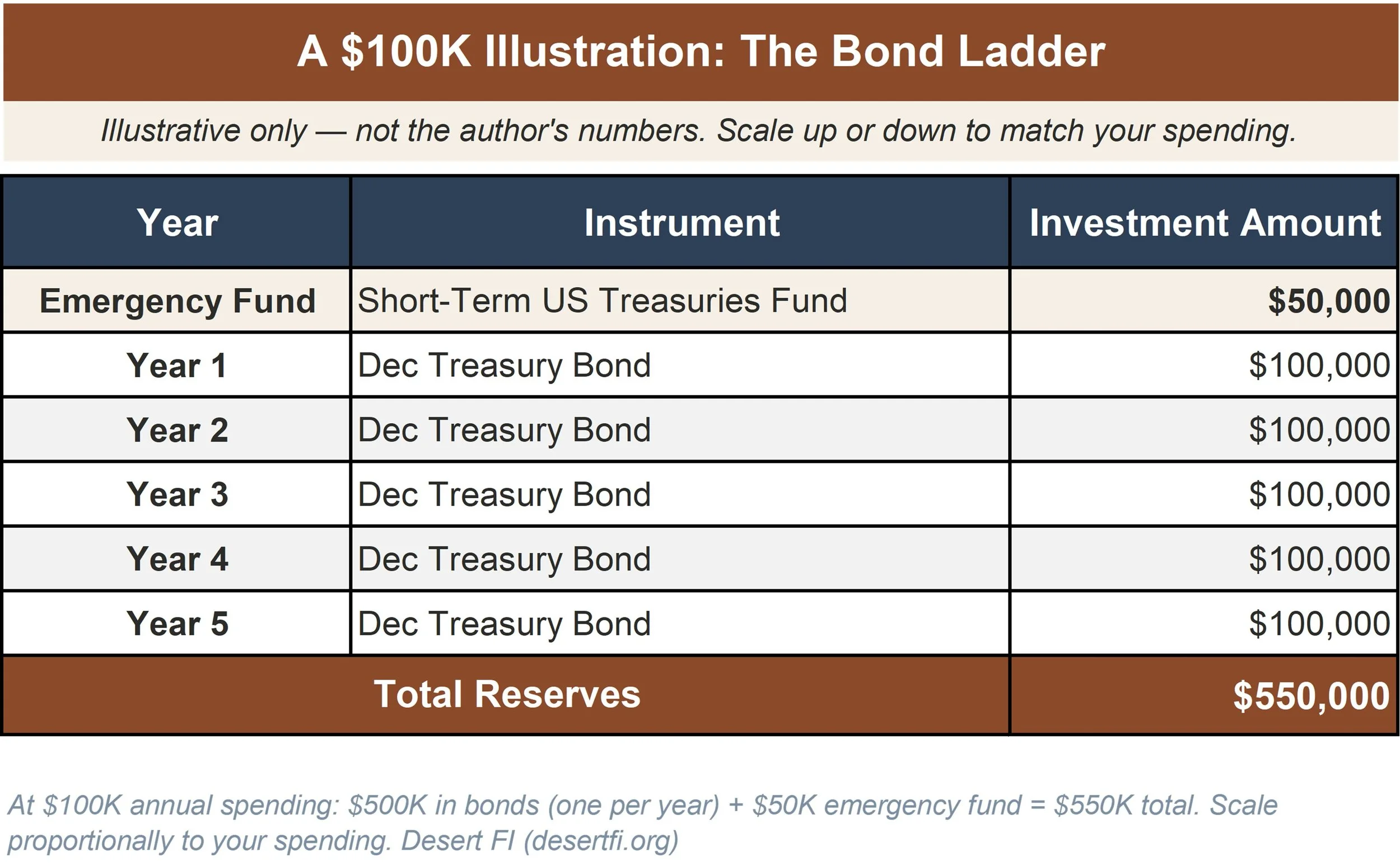
The ladder provides the structure. The annual evaluation determines which rung you draw from and when.
Decision Day: December 15th Annually
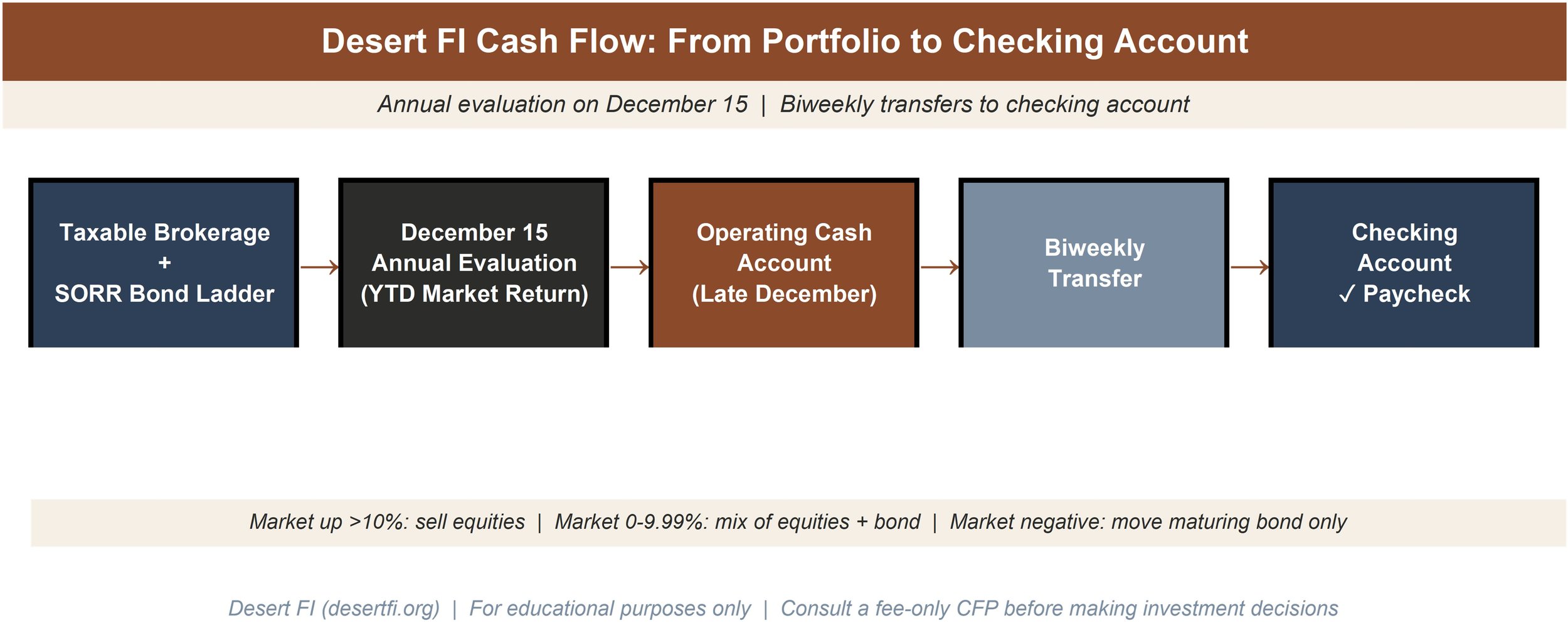
Every year on the market close of December 15, or the next trading day if it falls on a weekend, I plan to evaluate where to position funds for the following year. The date is deliberate. This ritual gives me a moment each year to reset, breathe, and make decisions from clarity rather than emotion.
I evaluate year-to-date performance through approximately December 15 rather than waiting for December 31. The last two weeks of December tend to reflect tax-driven activity rather than true market performance. Year-end tax loss harvesting, rebalancing, and fund distributions create volatility that doesn't reflect what the market actually did during the year. I don't want that noise influencing where I draw funds for the following twelve months.
The evaluation produces one of three outcomes based on equity performance:
Market up more than 10%: My first priority is funding the following year's living expenses from the taxable brokerage. Within the equity portion of the portfolio, I evaluate allocation against my 70/30 target and within equities against my 2/3 US and 1/3 international target. Rebalancing takes priority. If I'm at target allocation, I sell higher cost basis shares first, knowing that lower cost basis shares are earmarked for donation to our donor advised fund as part of our normal giving. If the market is up significantly beyond 10%, I also replenish the bond ladder, adding a bond to the outer year to maintain the five-year structure.
Market up 0% to 9.99%: Similar analysis, but the decision involves a mix of selling securities and potentially drawing from the nearest maturing bond depending on allocation and what tax optimization opportunities exist near the calendar year breakpoint. The flat scenario is where tax loss harvesting or tax gain harvesting decisions matter most, and where making the decision in mid-December rather than early January creates the most flexibility. Rebalancing to target allocation will be a factor in deciding which shares to sell, if any.
Market negative: Move the nearest maturing bond to the operating account and leave equities entirely untouched. No selling at depressed prices. No locking in losses, unless it's to harvest capital losses and repurchase similar but slightly different market positions to take advantage of tax savings. The bond does its protective job and the equity portfolio recovers undisturbed.
For readers whose assets are primarily in tax-deferred accounts rather than taxable brokerage, the same evaluation logic applies but the tax considerations differ. A future post will cover that territory.
One important inflection point: as I approach and pass age 59.5, the logic may shift. Penalty-free access to traditional retirement accounts opens new replenishment options that don't exist before that threshold. The framework described here is designed for the pre-59.5 window. The post-59.5 version evolves as those accounts become accessible.
Replicating the Paycheck
One of the most underappreciated dimensions of the transition is the rhythm of income, and it's worth thinking about deliberately rather than figuring out after the fact.
For as long as I can remember in my working years, I've been paid every two weeks. In a 52-week year, that means 26 pay periods, two more than being paid twice a month. Bills were timed around it. Vacations were planned around it.
My plan is to begin biweekly retirement transfers the week immediately after my last corporate paycheck, with no gap between them. At Ally, my online bank, biweekly transfers can be set up from an external account on a standing schedule. For readers who prefer the first and fifteenth of the month, two monthly transfers of 50% each accomplish the same thing. Some of you may have been paid weekly or monthly during your working years, and that structure can also be replicated in retirement if it's what feels most familiar and comfortable.
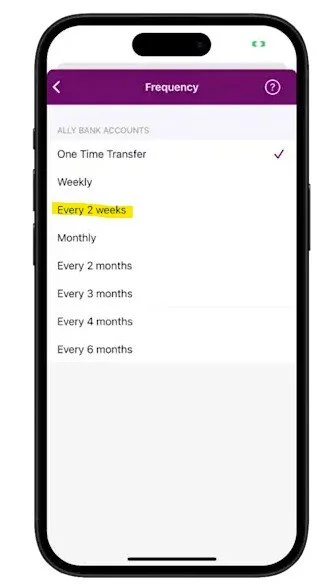
One unexpected benefit of maintaining the biweekly structure: two months each year will naturally have three transfers rather than two, exactly replicating the three-paycheck months. We always took vacations in those months. I see no reason to stop.
Each financial institution has its own transfer rules and each retiree will find their own rhythm. The right answer is the one that feels familiar enough to be sustainable.
I've started managing my personal calendar using a dedicated account the same way I've done at work for decades. These are small things. But in the early months of a major transition, continuity isn't trivial. It's the bridge between the life you built and the one you are building.
Knowing how my mind works and how many readers' minds may work, I can almost hear the question: how specifically do you plan to move money between the different accounts to replicate your paycheck? To help pre-answer that question, here's a quick graphical illustration.
So How Does It Feel?
Moving those funds from equities into bonds and Treasury accounts felt really, really good, even for a long-term US equities investor. It was second only to the moment I funded the Life Fund, an optional fourth bucket I described in The Sequence That Determines Whether Your Retirement Lasts, sitting at my primary bank, waiting for Countdown Day and a great sale on flights to Australia and New Zealand when I have the flexibility to enjoy some slower travel.
I feel a genuine peace having this level of liquidity. I've locked in the financial components of the plan almost a year in advance.
I want to be honest about the source of that peace. It doesn't come ultimately from the plan or the spreadsheet or Jack's validation, as meaningful as all of those things have been. It comes from a deeper place. The peace I feel isn't the peace of someone who has eliminated uncertainty. It's the peace of someone who's done his best to exercise good judgment in an uncertain world and trusts that the rest isn't his to control. A mixture of planning, faith, and appropriate humility about not knowing the future, working together in tandem: that's what I hope and expect will see us through those early years.
If this kind of transparent planning conversation is what you’re looking for, Weekend Reflections goes out every Sunday morning. Join us at DesertFI.org/join.
What I Am Still Working On
If I'm being fully honest, there are aspects of the plan I haven't yet taken to the deepest level of detail. Which specific lots to sell and when. The full tax implications of funding Roth conversions versus the conversions themselves. Some of that is intentional: I don't yet have the time and mental bandwidth to think through every scenario while running a demanding full-time role and building a Next Endeavor simultaneously.
The word I want to keep front of mind is agility. Mike Tyson said everybody has a plan until they get hit in the mouth. Retirement is no different. You can study it, model it, and validate it with a CFP, and still encounter things in year one that no spreadsheet anticipated. Much like marriage, you can pre-decide a great deal and still find that living it teaches you things no amount of preparation could. The goal isn't a perfect plan. It's a resilient one.
I have enough to execute confidently. The rest I'll refine in the first year after the downshift when I have the time to think rather than just plan.
Where Are You in the Process?
A few questions to consider as you reflect on your own drawdown framework:
If you're several years out: How robust is your current thinking about drawdown sequencing? Have you begun mapping out how you'll fund expenses without touching equities in a down market? If not, the time to start is now, while you still have earning years to fund the transition thoughtfully. One concrete step: build a rough version of the bucket structure above using your own spending number and identify the gap between where you are and where you want to be.
If you're getting ready to retire or downshift: Have you had your plan independently validated by a trusted friend with financial expertise, a fee-only CFP, or a financial advisor with no stake in the outcome? Jack's involvement gave me something my own Excel model couldn't: the confidence that I hadn't missed anything important, and my wife's peace of mind hearing it from someone other than me. If you haven't had that conversation, it's worth prioritizing before you pull the rip cord.
If you've recently retired or downshifted: What is one step you could take this month to refine your plan ahead of the inevitable next market correction? Not during the correction, when decisions get emotional, but now, in the calm. Map out your decision tree for each market scenario. Write it down. Make the decisions before you need them.
In Closing
Eight years after that March drive through the Valley of the Sun, our life, relationships, and love of the Southwest are stronger than ever. What was once unfamiliar and slightly nerve-inducing is now familiar and comfortable: the white cars, the saguaros, the twenty-color sunsets that never get old.
The transition from accumulation to distribution will require the same patience. What feels foreign now, holding bonds, evaluating allocation tiers, thinking in buckets rather than one growing number, will become a new instrument panel for navigating a different but more meaningful season.
While this was a deep dive into one person's plan, my hope is that hearing one fellow trail walker's path to the great unknown, and some of the gear we've packed to prepare for the journey, helps you think through your own unique situation. Drop a question or comment below. The terrain is different for everyone. The preparation is worth it for all of us.
Part 2 drops next Tuesday. It covers the year, month, and day to choose, the one more year tractor beam that will try to keep you at your desk, and the benefits and tax windows that only open in your final working year.
Thanks for being here along the journey.
Let's make wise choices and live a great life together.
🌵 Desert FI
Want to go deeper?
Become a Desert FI Insider. A plan you can live on is easier to build with company. Insiders get Weekend Reflections every Sunday morning plus free Insider-only resources, including the Well-Timed Exit Checklist, the practical companion to the Landing the Plane posts. If you’re not on the trail with us yet, join at DesertFI.org/join.
Already an Insider? Here are three posts worth exploring:
Landing the Plane, Part 2: Timing Your Exit and Maximizing Your Final Working Year: on timing your exit and your final working year
The Sequence That Determines Whether Your Retirement Lasts: on sequence of returns risk and how to protect against it
7 Questions to Ask in Building Your Downshift or Retirement Budget: on the seven questions behind a retirement budget