
Halloween is one of my favorite nights of the year. I don’t love it for the monsters or the scary front yards. I love it for the kids’ wonder, for seeing neighbors I don’t see as often as I’d like, and for walking around with scores of happy kids on a sugar high, right up until they crash.
There have been a lot of great ones, but the one I remember most was 2016. Our son was 11, and he wore a full plastic skull mask with tiny slots to breathe through, skeleton gloves, and a sword. From the neck down, he was dressed for the weather, in a baseball tee and shorts. It was in the 70s that evening, and the city where we lived was often humid, so let’s just say it was a little warm.
Our neighborhood had more than 800 homes. He’s always been a numbers and goals kid. His dream that year was to fill a pillowcase with his favorite candy, one bucket at a time, and he wasn’t going to be left behind. So we walked miles at a fast pace, and that mask turned into a sauna. His head was soaked with sweat. The costume looked epic on the porch, but it just wasn’t built for that night, or for his goals. (I’ll share a photo from that night at the end.)
I think about that mask every Halloween, and it’s a good picture of benefits enrollment this time of year, too. The choices that look best on paper aren’t always the ones that work for the life you’re living. Your benefits have to fit the person wearing them.
This month’s series is The Harvest. Fall is when a year of work comes in, and November is a good month to gather what you’ve been given, share it, and give thanks for it. We start with gathering. Your benefits are part of your pay, and stewardship starts with not leaving them in the field.
To help you find the advice for where you are in the journey, I’ll use four seasons throughout, each with its own icon:
🌱 Planting (10+ years out): building income, habits, and protection.
🌿 Growing (3 to 10 years out): building flexibility for an earlier exit.
🌾 Harvest (the next year or two): collecting what you've built before your benefits end.
🍂 After the Harvest (retired or downshifted): your enrollment season is happening now too, and there's a section for you near the end.
Most enrollment guides are written for people who plan to stay. This one is written for people who want options, so I'll ask one question of every benefit: does this help buy your freedom sooner? Some benefits protect the path, some build the bridge to Medicare, and a few are noise you can skip.
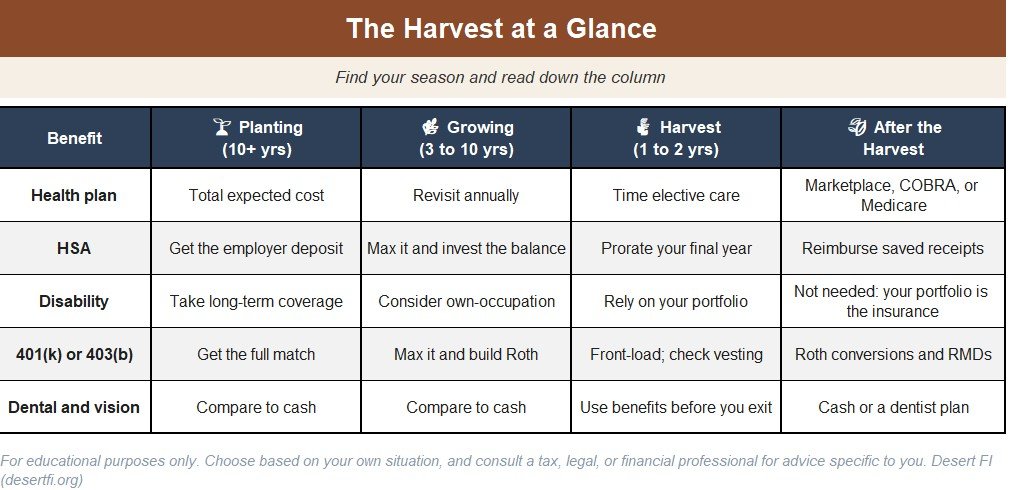
Here's the whole post on one page. Find your season and read down the column.
Your Health Plan
Start by looking back. Pull last year's medical, dental, vision, and prescription costs and think about the year ahead. An AI tool can turn a stack of statements into a spending summary in minutes, but redact Social Security numbers, birth dates, and account numbers first, use a paid subscription, and turn off the setting that lets the company train its models on your data.
Choosing a plan depends on your family's health. If someone has a chronic condition, like a child with Type 1 diabetes, an ongoing disability, or an expensive medication, a top-tier plan (often called a Gold plan) may be worth the higher premium. You'll pay lower copays from the first visit instead of covering most of the bill until you hit the deductible. A $20 copay beats a $300 specialist visit. That's not worth paying extra for if you rarely see a doctor, but it helps a lot when you're seeing doctors every week for a long-term illness or an acute issue like cancer.
If your family is relatively healthy and you rarely hit your deductible, look closely at a high-deductible health plan. Many are bronze-level plans, and a qualifying high-deductible plan is what makes you eligible for a Health Savings Account (HSA). Premiums are lower, and many employers deposit money into your HSA because the plan costs them less too. Treat that deposit like a 401(k) match. It's free money. This is the skull mask decision: the plan that looks most generous on paper may not fit how your family uses care.
🌱 Planting (10+ years out) and 🌿 Growing (3 to 10 years out): Choose on total expected cost, premiums plus what you realistically expect to spend, and revisit every year.
🌾 Harvest (the next year or two): If you continue your employer plan through COBRA after you leave, you're usually on the same plan, so your progress toward this year's deductible generally carries over. A new ACA Marketplace plan starts the deductible over, so time elective care with your exit in mind. I covered the post-exit options in Landing the Plane, Part 2.
Like a Roth, But Better: The Triple Tax-Advantaged HSA
We started contributing to an HSA around 2018, after years with a health care FSA. In the early years, we spent from it as expenses came up. Over time we used it less, and eventually not at all, so it could grow. I don't have regrets about those early years. We did what we could with what we knew. But many of us picture an HSA as a spending account for copays, and it's far better than that. In many ways it beats a Roth.
The HSA is triple tax-advantaged:
Your contributions are tax-deductible.
You can invest the money in low-cost index funds, and it grows tax-free.
Withdrawals are tax-free when you use them for qualified medical expenses.
Through the lens of an earlier exit, the HSA is your bridge. Health care before Medicare is one of the biggest worries for anyone leaving work in their 40s or 50s, and a well-funded HSA is money set aside for exactly that. If you can afford it, pay medical costs out of pocket, save the receipts, and let the balance grow. There's no deadline to reimburse yourself for qualified expenses incurred after you opened the account, so a receipt from today can come out tax-free decades from now.
I've tracked our HSA-eligible expenses since 2020. My spreadsheet has a row for every expense, with who we paid and how, plus two check boxes: one for the itemized receipt and one for the payment receipt. A formula keeps a running total of care we've paid for but haven't reimbursed yet.
Nobody wants to feed receipts one page at a time into an old-school scanner. My phone does it in seconds, straight into a cloud folder, whether I'm at the pharmacy counter, the doctor's office, or the kitchen table. My habit is one two-page PDF every time: the itemized bill and the payment receipt.
I plan to start drawing on our HSA in my mid to late 60s, once I'm on Medicare. Until then, it's a backup lever if we ever face major medical bills in a down market, particularly in the early years when sequence of returns risk is highest. I wrote about it in The Sequence That Determines Whether Your Retirement Lasts.
For 2027, the IRS limits are $4,500 for self-only coverage and $9,000 for family coverage, plus an extra $1,000 if you're 55 or older. One caution: California and New Jersey tax HSA contributions and earnings at the state level, so check your state's rules. The HSA is still attractive there, just less so.
🌱 Planting (10+ years out): Capture any employer deposit and build toward the limit as your budget allows.
🌿 Growing (3 to 10 years out): Push toward the full limit, invest the balance, and start saving receipts. This is where the long runway pays off.
🌾 Harvest (the next year or two): If you leave an HSA-eligible plan partway through the year, your limit is generally prorated by the months you were covered. You can keep contributing after you leave if you're on an HSA-eligible COBRA or ACA Marketplace plan, and the account goes with you.
Disability: The Benefit That Protects Everything Else
If you take one thing from this post, take this section.
If you’re still building, your ability to earn is the engine of your whole plan. It funds the savings, the HSA, and the Roth, and it's the path to financial independence itself. According to the Social Security Administration, a 20-year-old today is more than twice as likely to become disabled before age 67 as to die before that age. Yet many of us buy life insurance without a second thought and skip right past disability coverage.
When we lived in the Southeast, a man I knew from church was in a motorcycle accident in his 40s. I saw the impact on his family up close. His cognitive injuries meant he could never return to full-time work. Social Security Disability Insurance (SSDI) exists, but its benefit is modest next to a full-time wage, and it’s based on your lifetime earnings record, not your current salary.
Realizing how fragile that income engine is changed how I looked at employer policies. Here's how the two kinds of coverage usually work:
Short-term disability replaces part of your pay for the first few months. Employers often pay for it or let you use PTO, and a three-month emergency fund can cover the gap.
Long-term disability starts after a waiting period, often 90 days, and can last for years. It's the coverage you usually buy, and the one an emergency fund can't replace.
Watch two things. First, a plan that pays 60 percent of salary often has a monthly cap, and bonuses, commissions, or stock compensation often don't count at all. Second, taxes. If you pay premiums with pre-tax dollars, the benefit is taxable. If you pay with after-tax dollars, it's generally tax-free. Very few families I know could live on 60 percent of their pay, and after taxes, a pre-tax benefit can shrink to something closer to 40 or 50 percent. That's sobering.
I didn't always get this right. When our son was young and my career was still growing, so many things competed for our dollars that I didn't buy extra disability coverage at all. Around 2015, I started buying it, and I chose the pre-tax option for the savings and knowingly rolled the dice. Around 2020, with more margin and a better understanding of the risks, I switched to paying after-tax.
🌱 Planting (10+ years out): This is your most important protection. Take the long-term disability coverage, and buy extra if you can.
🌿 Growing (3 to 10 years out): Keep it until your assets could replace your income. In a specialized, high-income field, like medicine, law, academia, or senior leadership, consider an individual "own occupation" policy. Many group policies stop paying if you can do any job at all.
🌾 Harvest (the next year or two): Group coverage generally ends with your last paycheck, and once you're financially independent, your portfolio becomes your disability insurance. Buying extra coverage you'll lose in a few months rarely makes sense.
Your 401(k) or 403(b): How Much and Which Kind
If disability coverage protects the field, your 401(k) is where most of the harvest gets stored.
How much. At a minimum, contribute enough to capture your employer’s full match. Skipping it leaves part of your pay in the field. Beyond that, work toward a 25 percent savings rate once you have an emergency fund and your non-mortgage debt is paid off. In parts of the FIRE community, you'll hear about 40 or even 50 percent savings rates. I never quite got there. More is better, as long as you're still enjoying a good life now.
My own order for filling the buckets looked like this:
An emergency fund.
The full employer match.
The HSA.
A Roth IRA for me, and one for my spouse.
The rest of the 401(k), up to the limit.
A taxable brokerage account.
It took me years to fill all of these, and it got much easier once our house was paid off. I wrote about that in Five Financial Decisions That Made My Downshift Possible.
At the time of this writing, the IRS hasn't finalized the 2027 limits, but to give you a sense: for 2026, the employee contribution limit is $24,500, plus an $8,000 catch-up at 50 or $11,250 for ages 60 through 63.
Which kind. I loved the Roth 401(k). I loved it so much that I stayed in it for years after my tax bracket said I shouldn't. It feels foolish looking back, but my thinking was simple: I might pay more in taxes now, but I'd have more valuable retirement accounts later. The higher our bracket climbed, the less sense that made. In 2020 I finally studied it properly, estimated our tax rate in retirement, and said, "This is crazy. I'm getting killed with taxes." I switched to traditional contributions.
The key question is your tax rate now versus your expected tax rate in retirement. As a very general rule of thumb, if your household income is under about $200,000, lean Roth. Above that, lean traditional. Your situation can flip that, for example, if you own a business you plan to sell or you expect a large inheritance. A fee-only CFP or a CPA can pressure-test the answer.
Two details trip people up. Your employer's match usually goes in pre-tax by default, even if your own contributions are Roth. And if your FICA wages from that same employer last year topped about $150,000, any catch-up contributions you make at 50 or older must now go in as Roth. The threshold is indexed for inflation, so check the current figure. If your plan allows after-tax contributions you can convert to Roth, look into a mega backdoor Roth. I never had the option, but I would have used it.
🌱 Planting (10+ years out): Capture the full match, and raise your contribution 1 percent a year until you reach your target.
🌿 Growing (3 to 10 years out): Use catch-up contributions after 50. Build Roth and taxable money alongside your traditional balance, so you have options if you leave before 59½. I covered how I sequence those dollars in Landing the Plane, Part 1.
🌾 Harvest (the next year or two): Contributions only come out of paychecks, so front-load them if you want to max out in your final year. Check your vesting dates and any year-end match true-up you'd forfeit. If you leave in or after the year you turn 55, the Rule of 55 may let you take penalty-free withdrawals from that employer's plan, so think twice before rolling everything to an IRA.
Quick Hits
The rest of the field holds smaller crops, but they add up.
Flexible Spending Accounts. A health care FSA is use-it-or-lose-it. The 2027 limits haven’t been finalized either, but for 2026 the limit is $3,400, with a carryover of up to $680 or a short grace period if your plan allows it. A dependent care FSA covers up to $7,500 per household. You can’t contribute to an HSA while you’re covered by a general-purpose health FSA, but a limited-purpose FSA for dental and vision, if your employer offers one, works alongside an HSA.
🌾 Harvest (the next year or two): Under the uniform coverage rule, your full annual health FSA election is generally available from the first day of the plan year. Check your plan's rules before you count on it.
Dental and vision. These plans often work more like prepaid plans than insurance, so compare them against paying cash. This year I finally asked our dentist whether they offered their own plan. For $199 a year, they cover two cleanings, X-rays, and fluoride, which our insurance doesn't cover and costs me $25 twice a year. Members also get 20 percent off fillings or crowns, with emergency fees waived. Covering my wife and me is $349, and adding our college-age son brings it to $449. A typical family dental PPO runs about $650 a year, plus $150 in fluoride for the three of us. It isn't life-changing savings, but it's a better way to buy the same care. One caution: our dentist's plan doesn't include orthodontics, which could tip the scales toward insurance in the braces years. Check your plan's specifics, compare what's available, and then decide.
🌾 Harvest (the next year or two): Use every benefit before you go. Get the exams and cleanings, and buy the extra pair of glasses.
Life insurance. Group coverage usually ends when you leave, so if anyone depends on your income, an individual term policy bought while you're healthy is often the better foundation. For our family, the plan was to keep life insurance in place until our son graduated from college. With graduation in sight and the advice of a skilled CFP who is helping us build our downshift plan, we recently canceled most of it.
Other Benefits Worth a Look
Supplemental health policies like accident, critical illness, or cancer coverage. If you hold six to twelve months of expenses in cash and cash equivalents, your emergency fund already covers these risks.
Legal plans can be worth it if your will or estate documents are out of date. Online legal form services work too, and if you give regularly to a charity or your church, ask whether it offers free estate planning through a partner. My wife and I set up a well-designed trust at no cost through a legal partner of our local church.
One more thing for the fourth quarter: beneficiaries. Confirm that both you and your spouse have a beneficiary on every account, and that joint accounts carry rights of survivorship. Both of my parents have died in the last decade, and my father-in-law before that. Correct designations make the process far smoother for the people you love and let them reach funds quickly instead of waiting on probate, which often takes months and sometimes more than a year.
🍂 After the Harvest: If You've Already Left Full-Time Work
Your year-end harvest looks different, but it's just as real.
ACA Marketplace open enrollment began November 1 in most states. Shop again instead of auto-renewing, and remember that a Roth conversion or large capital gain can change your subsidy. A spouse's or part-time employer's plan may have its own enrollment, and the sections above apply there too.
Find a good broker. I highly recommend a broker who specializes in ACA plans. They're generally paid by the insurers, at no cost to you. The Catching Up to FI podcast recently ran an excellent two-part series on health insurance for early retirees with Lyndia Cunningham of Move Health. I met with her afterward and found her extremely helpful. If you're in the Harvest season, also compare COBRA. It may be closer in price to an ACA plan than you’d expect, often with lower deductibles and out-of-pocket maximums.
Check your college student's options. If you have kids in college, compare the school's student health plan with keeping them on yours. Our son is moving to his school’s plan, which costs less and covers more than our plan. He'll pay the bill himself with money we give him, so he starts seeing a cost he'll carry on his own soon. I wrote more about that kind of preparation in The Retirement Line Item Nobody Budgets For: Adult Kids.
Medicare open enrollment runs October 15 through December 7. Review your Part D and Medicare Advantage choices, since formularies and networks change every year. Medicare specialists can help, especially if you just turned 65 and are enrolling for the first time.
Year-end tax moves carry a December 31 deadline. Consider Roth conversions in a low-income year, harvesting gains in the 0 percent capital gains bracket, and tax-loss harvesting. And if you’re 73 or older, don’t miss your required minimum distribution.

Dressed for the weather from the neck down. Dressed for glory from the neck up.
Gather What You've Been Given
Our son didn’t quit that night. Mask and all, he kept going, because the goal was worth it. He chose that costume for the porch, and then he had to wear it for miles. Benefits work the same way. Choose for the night you’re having, not the porch photo, and the harvest gets a lot easier to gather.
Most mornings start the same way for me, with prayer, reflection, and a chapter of Proverbs. I'm amazed at how timeless that wisdom is and how much it still has to say about money and planning. One verse fits this season well: "The plans of the diligent lead surely to abundance, but everyone who is hasty comes only to poverty" (Proverbs 21:5, ESV). Enrollment takes a few hours of diligence once a year, and it pays all year long.
One step for this week:
🌱 Planting: Capture the full match and take long-term disability coverage.
🌿 Growing: Max your HSA, invest it, and start a receipts spreadsheet.
🌾 Harvest: List your vesting dates, true-up rules, and every benefit to use before you go.
🍂 After the Harvest: Put your Marketplace or Medicare review on the calendar.
Which benefit do you wish you'd understood sooner? And if you've already left full-time work, what would you tell someone choosing their benefits this month? Leave a comment below. I read and reply to every one.
Let's make wise choices and live a great life together.
🌵 Desert FI
Want to go deeper? Become a Desert FI Insider. A good harvest starts with knowing what's in the field. Insiders get Weekend Reflections every Sunday morning plus free Insider-only resources, including the Well-Timed Exit Checklist, the FINE Number Calculator, and reflection guides to help you plan for the season you're in. If you're not on the trail with us yet, join at desertfi.org/join.
Already an Insider? Here are three posts worth exploring:
The Noises in the Night: Five Retirement Worries That May Wake You at 3 A.M.: on the worries that show up after the plan is built, and one step for each
Why $20K a Year Changes the Retirement Math More Than You Think: on how a little flexible income buys freedom sooner
Not the Lattes. Here’s What Actually Retires You Early.: on the big levers behind an earlier exit and how to test them