The Four Types of Work, and the One Most People Never Reach

My lungs and legs were burning by the third mile.
Straight up, few switchbacks, chains and rock holds as I approached the summit. My backpack was full even though my heart felt empty: water, lunch, my journal and a few books I was wrestling through. For almost a decade, I had been doing meaningful work that really mattered, and it was time to make a decision about whether to continue on my current path or blaze a new one.
As the sun broke through the morning grey, I finally began to crest the summit, a favorite overlook deep in the Blue Ridge Mountains, a world away from the desert I'd eventually call home, and prepare for some real wrestling: with God, with myself, and with what I wanted to be when I grew up. I breathed a silent prayer and the words came to mind: I lift my eyes to the hills; where does my help come from?
I sat at the overlook for four hours. Maybe five. I prayed. I ached. I wrestled and I reflected. I watched the sun and the clouds slowly move across the sky and tried to see my own life with the same clarity and time-lapse distance.
A few days earlier, I had sat down for a heart-to-heart with my Director at the non-profit I called home. Growth and impact were strong. My fundraising was top 5%, but I was already at the top of the pay scale at $40,000 a year. With a new baby on the way and a wife who wanted to be home for the early years, I had asked, carefully and respectfully, whether there was any room to move. There were staff across the country struggling to stay above the poverty line. There simply wasn’t flexibility in the system.
No bitterness. None. I understood it completely.
But sitting on that overlook, I had to be honest with myself about what the decision actually was. I could keep doing three things exceptionally well: loving the work, being genuinely skilled at it, contributing something the world needed. Or I could acknowledge that the fourth thing , the income that sustains a family, wasn't going to come. Not in any meaningful way. Not here.
For those who are spiritually curious or have a faith, there's often the question of whether God has a specific will for your life: who you should be with, what job you should take, where you should live. I've found that the boundaries are marked out, but there is freedom to weigh, decide and act. God is faithful to hem us in when we go astray. The freedom and the responsibility for our choices mean we should make wise ones and hold them with open hands.
I didn't have a name for what I was working through that day.
I do now.
The Framework Most People Have Heard Of And Almost Nobody Has Actually Applied
There's a Japanese concept called ikigai, loosely translated as "a reason for being." The western adaptation maps it onto four overlapping circles: what you love, what you're good at, what the world needs, and what you can be paid for. Here's what I've learned about those four circles and why the intersections matter as much as the circles themselves.
The center, where all four overlap, is the place most frameworks point to as the destination. But most stop short of telling you how to actually get there, or why most people never do.
What the framework doesn’t usually tell you, what most people never think to ask, is how many circles their current work is actually hitting.
Because most work hits one or two. Some work hits three. Very few people ever reach all four.
And the reason most people never reach all four has almost nothing to do with passion or skill or purpose.
It has to do with financial pressure.
Think about when you were a child. A teacher probably asked you what you wanted to be when you grew up. You may have answered astronaut, veterinarian, baseball player, or firefighter. Money was the last thing on your mind. You wanted something cool. Something that mattered. Something that felt alive.
But somewhere between those days of quiet dreaming and the realities of starting salaries and stability and respectability, life got in the way. And you left those childhood dreams in the crayon worksheet.
The four circles are partly an attempt to recover what that worksheet knew before the world complicated it.
The Four Types of Work
Take a moment with the diagram below. Look at the four outcomes mapped at the intersections. Look at them and really study the dashed descriptions of what partial balance actually produces. Happy but hungry. Rich but restless. The key isn't hitting one circle deeply; it's building toward multiple levels of meaning simultaneously.
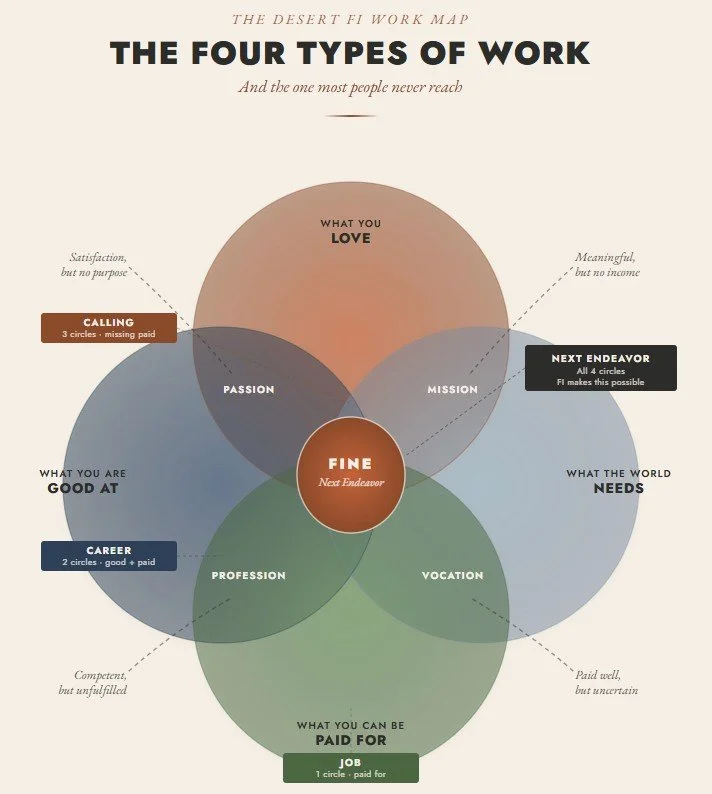
Here's what each stage actually looks like:
A Job hits one circle.
My son spent a couple of summers working at a fast food restaurant in early college. Decent job. Good people. When he moved to a position paying $1.50 more per hour, that raise was a genuine event in his world. He wasn't particularly passionate about the work and it wasn't aligned with his deepest values or his long-term direction, but it paid reliably, and there's real dignity in that. He also didn't carry it home. Clock out and you're done. A Job asks one thing of you: show up and earn. Nothing more is required.
A Career hits two circles.
There's a saying from business school: 40 Ps equals $100K. Pass your forty classes and earn a credential worth a six-figure salary. What nobody tells you is that the credential means considerably less when the market has collapsed. The Great Recession had little use for former non-profiteers with roughly one year of real-world business experience. I took the only job I could find: 100% commission sales.
The income was real but lumpy, around $65K in a good year, less when it wasn't. The $100K we'd dreamed about felt perpetually one good quarter away. The trajectory was there to do significantly more over time. But with a young family and tight months that tested every budget discipline I had, when a salary-plus-bonus position appeared, the security was worth more than the potential. I took it. I don't regret it. But I noticed what I was choosing.
I worked hard and treated the transition into a corporate role as a cross-cultural experience: listen, observe, ask clarifying questions, and begin to assimilate. Over several years, something that looked like a Career began to take shape, and I became genuinely good at the work and it provided well for my family. Competence plus compensation. Many people spend their entire working lives here, and much more is available if you choose it. I wrote more about that arc in From the River to the Corner Office.
A Calling hits three circles.
The non-profit work was a Calling. Looking back, it’s obvious. I loved it deeply: the students, the stakes, the meaning of it. I was genuinely skilled at it. And the world needed exactly what I was offering: a guide for young people trying to figure out who they were and what their lives were for.
I took students to Romania to teach English to young people whose economic futures depended on their fluency. I stood with a group of twenty-year-olds in London as we visited a mosque, a Hindu temple, and a Sikh temple. Part of the purpose was to help students understand the world they'd been sent into and to seek understanding before being understood, to see another person's faith on its own terms. I watched something shift in those students that I knew would never fully shift back. Three circles, firing almost perfectly.
The Fourth Circle just couldn't carry a family.
A few years later, as I became more conversant in business and was trusted with more responsibility, my corporate career became a Calling too in a way that truly surprised me. I genuinely loved the problem-solving, the team-building, the satisfaction of delivering something meaningful while doing it with integrity. I’ve worked with people I respected and helped create environments where the work itself was better because of how we chose to do it. There were years where I would have done the work for free. And honestly, for a lucky few, that’s exactly what all four circles in balance looks like: not a framework but a lived reality, at least for a season.
With the exception of one difficult season I own entirely, I loved it. But over time, we change. Our horizons broaden. And the thing that brought such satisfaction can start to feel, slowly and without drama, like something that no longer fits the person you're becoming. I wrote about this more extensively in The Gilded Cage.
Two or three circles are still firing. The fourth is stronger than ever.
But I've started to wonder what it would look like if all four were pointing in the same direction.
The Circle Most People Never Talk About
Here's what the framework doesn't say directly but implies in every diagram:
The fourth circle, what you can be paid for, carries everything.
For most people, the monetary circle isn't one of four equal contributors. It's the load-bearing wall. It pays the mortgage. It funds the retirement account and covers the health insurance. It determines whether the other three circles get to be part of the conversation at all.
When the fourth circle has to carry everything, it distorts the other three. You can't say no to paid work that doesn't fit your values. You can't slow down when meaning requires it. You can't experiment with the Calling that might take three years to find its footing before it generates income. The pressure of the fourth circle crowds out everything else.
This is why most people never reach the intersection of all four.
Not because they lack the passion. Not because they lack the skill. Not because the world doesn't need what they have to offer.
Because they can't afford to let the fourth circle become optional.
What Changes When the Fourth Circle Only Needs to Contribute
I believe FI isn't a number you cross. It's a continuum, and where you land on that continuum is deeply affected by whether your Next Endeavor is generating meaning, income, or both. A well-aligned Next Endeavor doesn't just supplement your portfolio. It can be the difference between a retirement that feels like survival and one that feels like flourishing.
FI doesn't eliminate the fourth circle. It doesn't mean you stop caring whether your work generates income. It means the fourth circle shifts from carrying everything to contributing something.
For many people approaching FI, a portfolio can carry the heavy lifting: shelter, food, healthcare, the basic architecture of a sustainable life. For some, full retirement is exactly right, and a retirement built around genuine purpose, meaningful relationships, and the freedom a paid-off portfolio provides can absolutely be its own form of Ikigai. The fourth circle, having carried the weight for decades, finally gets to rest while the other three breathe. For others who want to retire earlier or keep a hand in meaningful work, the fourth circle in a Next Endeavor doesn't need to replace a salary. It needs to contribute enough to close the gap, fund the margin, make the math a little more comfortable.
Take someone with a $1.5M portfolio. At a 4.5% withdrawal rate, that's roughly $67,500 in Year 1, below the US median household income of $84,000. Add $20,000 from meaningful work and something genuinely changes: the withdrawal rate drops, the margin opens up, and retirement starts to feel less like a calculation and more like a life. More trips to see kids or grandkids. A week at the beach instead of a weekend. The occasional dinner out without mental math.
At that level, the question you're asking about your Next Endeavor isn't "can this carry my financial life?" It's something richer: "Can this contribute enough to protect me from early sequence of returns risk and improve my quality of life in the years when I'm most vulnerable?"
Those are different questions. They lead to entirely different kinds of work.
When the fourth circle only needs to contribute rather than carry, everything about how you build your Next Endeavor changes:
You can do it because you love it, not because you're counting on it to survive.
You can say no to work that doesn't fit the other three circles, because the FI math is already strong.
You can work a few days, off a few days. In the mornings when you're most creative, taking afternoons as they come. You can ponder a problem on a long walk with the dog, swim laps, disappear into a canyon for the afternoon. You can take a nap without guilt when you're tired, because you're not hustling for survival; you're supplementing to thrive.
The work that emerges from that freedom is different. Purer. Work that doesn't have the distortion of financial desperation built into it.
And here’s something worth saying directly: you don’t have to feel guilty about earning money from work you love. The worker is worthy of his wages, not defined by them, not enslaved to them, but worthy of them. Earning something from a calling isn’t a compromise of the calling. It’s the appropriate result of it.
That's Ikigai actually functioning the way it's supposed to: bringing harmony to what you love, what you're good at, what the world needs, and what you can be paid for.
Let me show you what that looks like in practice.
A little over a year ago, I taught a financial basics and budgeting course in my local community. Some listened. Others took small steps. One man (I’ll call him Gerald) caught the passion and did a complete 180. I ran into him recently. After working three jobs, including Uber on weekends, he had paid off $65,000 in debt and saved up a three-month emergency fund. For the first time in his adult life (he’s in his late thirties), he is debt free, saving for retirement, and running financial calculators to see what he needs and when he can retire.
That's one person. One course. One conversation that caught fire.
Stories like Gerald's are why I write, coach, and teach. They're also why I'm not worried about whether Desert FI becomes a business in the traditional sense. The Gerald moments don't require scale. They require showing up with what you know and genuinely caring about what happens next.
The fourth circle, when it only needs to contribute, gets to be built around moments like that.

The Question Worth Sitting With
On that Blue Ridge overlook, I sat with my feet dangling over the edge, just like I felt my life was. In that day of reflection, wrestling and praying, I found the wisdom and courage to walk a new path.
I had three circles. The fourth one wasn't available in the form I needed, and I didn't even know the question to ask yet.
So I made a change. I spent the next two decades building the fourth circle: learning the skills, accumulating the competence, earning the income that eventually became the financial foundation underneath everything else. Not just income, though. Actual saved and invested margin. The compounding kind. Real retained earnings that sat quietly in accounts, building the runway so that someday the other three circles could breathe.
What I didn’t know then, what I’m only now beginning to understand, is that the goal was never to let the fourth circle dominate. The goal was to build it strong enough that it could carry the weight, so that someday the other three could breathe.
That someday is close.
Desert FI is three circles firing. The kindling is ready to light the fourth.
And here's what I want to ask you wherever you are on this trail:
How many circles is your current work hitting?
And if you have savings, a portfolio, equity in a home, a retirement account that's been quietly compounding, how much weight is that financial foundation already carrying? How much more could it carry if you asked it to?
Because for almost everyone reading this, the answer to that second question is more than you think.
I believe you were made for purpose, meaning and contribution. Whatever you believe about where that impulse comes from (faith, philosophy, or simply the deep human instinct toward a life that matters), the pull toward all four circles is real. Honor it: not someday, now, in whatever season you’re in.
Not a burden. Not a necessity. Not the thing that crowds out everything else.
A contribution.
Let's walk with wisdom together.
🌵Desert FI
Want to go deeper?
Become a Desert FI Insider. How many circles is your work hitting? Insiders get Weekend Reflections every Sunday morning plus free Insider-only resources like the FINE Number Calculator, which shows what a modest Next Endeavor can do for your numbers. If you’re not on the trail with us yet, join at DesertFI.org/join.
Already an Insider? Here are three posts worth exploring:
Why $20K a Year Changes the Retirement Math More Than You Think: what a modest Next Endeavor does to the numbers
How to Find Your Next Endeavor: five paths to meaningful work
Three Versions of Enough: on knowing when you have enough, in three different ways