I can still feel the love of that group. It was 2009, and the financial markets were upside down. At home, we were reeling: my father-in-law had just been diagnosed with cancer, our four-year-old son was struggling in preschool, and the Great Recession had hit the industry where I worked. And yet four couples from our Life Group at church were there for us again and again. They listened. They prayed for us. They bought us gift cards and offered to babysit so we could get a night out. They talked about their own lives, which got our minds off the season we were in. They gave their time, and they expected nothing in return.
Honestly, it was hard to receive that kind of kindness, and it still is. Almost two decades later, I can't remember much of what they said. What I remember is the feeling that we weren't walking the trail alone. We were with friends who had our backs and carried our pack when we weren't strong enough to carry it ourselves.
This month's series is The Harvest. Last week was about gathering what you’ve been given, getting the most from your workplace benefits so they help buy your freedom sooner. This week is about sharing it, through our time, our money, our words, and the attitude of our hearts. We all hope to have friends like that group in a hard season. Most of us also want to be those friends, and there are more ways to do it than we might think.
Before we go further, I'm not here to guilt anyone into giving. If your heart already enjoys it, I want to help you do it well. If you're on the fence, I hope a story or two nudges you. And if you're wondering what's in it for you, I'll get to that, because giving changes the giver as much as the person on the receiving end.
We'll use a simple, time-tested framework: time, talent, and treasure.
Time: Leave the Edges of the Field
Gleaning is one of the oldest forms of generosity on record. For more than two millennia, farmers in the Ancient Near East intentionally left the edges of their fields unharvested and didn't go back for what they dropped. Whatever was left belonged to the poor and the foreigner, who could come and gather it for themselves. The practice still exists around the world. Volunteers walk farm fields and orchards after the harvest and gather what the seasonal workers or machines missed, and the food goes to food banks and soup kitchens.
When we lived in North Carolina, a group of parents took their kids gleaning on a school holiday, the kind of day off that wasn't a day off for most working parents. Our son was 11 and in sixth grade. My wife went with him, and they drove about 90 minutes up into the mountains. It was sunny, the mountain air was crisp, and she still remembers the smell of apples and autumn. They spent the day picking apples by the bushel, apples that would have gone to waste and instead fed families who needed them. On the way home, they stopped at a mountain apple stand for apple-flavored slushies and made their way through a corn maze.
I wasn't there that day. I was working. It was one of the weekday worlds I never saw.
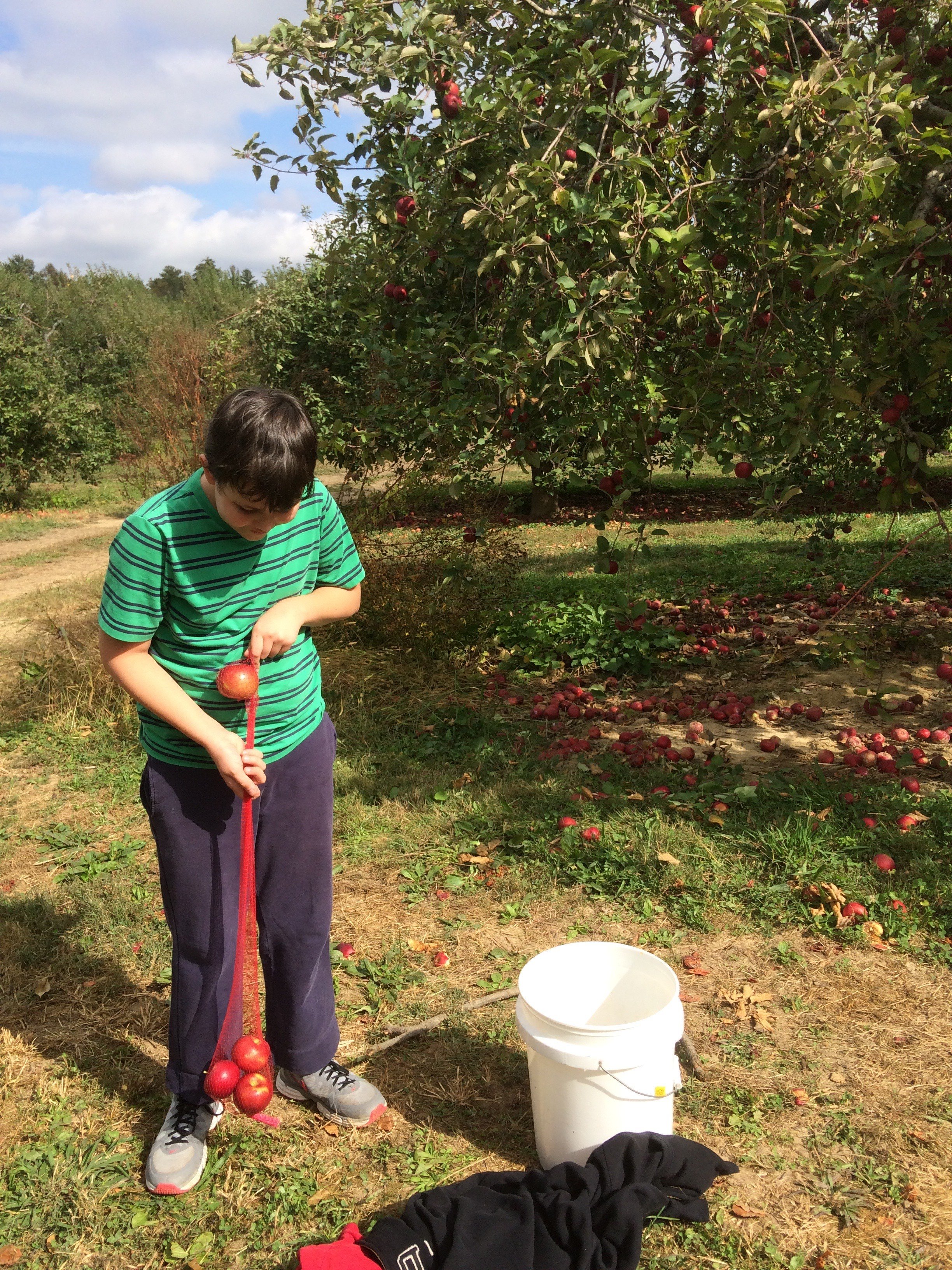
Desert FI Jr. on gleaning day, sixth grade.
That small fact matters more to me now than it did then. As a teenager, I did one-week Habitat for Humanity trips in Charleston and Baltimore. In my 20s, I traveled to Eastern Europe several times to teach English and help college students become more marketable. Those weeks shaped how I see service.
Here's my regret. In my corporate years, I never took a one-week service trip with my son. We did service days together, like weekend shifts packing food for people in need and painting classrooms at local schools. But vacation days were limited, and most of them went to visiting family or making memories together on vacation. That time mattered. The truth is, I was also too focused on delivering results for clients, starting a new role, or turning around a struggling business. Those immersive weeks of service had such an impact on me, and I wish I'd carved out one or two weeks to give my son that same experience, swinging a hammer beside him or teaching a classroom together. He's a senior in college now. That window hasn't closed, but it's narrower than it was, and more service trips are near the top of my list for the next season of life.
Now that I’ve downshifted in my early 50s, I’m grateful for what those years of hard work made possible. If you’re behind me on the trail and still working, time is probably the scarcest thing you have. Don’t let the time it takes or the perceived risk keep you from doing something that matters. Spend some of that time serving alongside the people you love, because that’s a gift to them too. If you’re already retired, time may be the richest gift you have to give.
Sometimes giving time takes as little as ten minutes. Last year, I was in San Francisco on a work trip, staying at a high-rise hotel downtown. One evening, two coworkers and I were walking back from dinner near Union Square. We were headed to the hotel bar to grab a drink and prepare for a meeting the next day. That’s when a homeless woman asked us for help. She wasn’t asking for money. She was hungry, and she asked for a meal. It was a cool evening. I was wearing a Patagonia jacket, and she was wearing a T-shirt. I could tell she was almost shivering.
Honestly, it felt a little awkward to stop and engage with her, but something about this moment and this woman was different. As I heard a little of her story, I remembered I had a free frequent-traveler food credit at my hotel. I asked where she'd be, walked back up the hill chatting with my coworkers, and bought her a cheeseburger and fries (her requested meal). Then I made the few-minute walk back down the hill to bring it to her and went on with my evening.
It cost me very little: a hotel food credit I didn't pay for, 10 or 15 minutes of my time, the small awkwardness of my coworkers watching me help a homeless woman, and arriving a little late to drinks. What it took was noticing the person in front of me and choosing not to brush her off, which honestly I don't always do. I share this because the gift was small, and that's the point. If you cultivate a generous spirit, over time the opportunities will find you, sometimes on a city sidewalk when you don’t expect it.
Talent: Give What You Know
One of my favorite examples of giving your talent comes from a chef in the Southeastern city where we used to live. This was an award-winning chef with white tablecloth restaurants. He opened a passion project nonprofit restaurant downtown, and all of its profits went to feeding people in need. Its kitchen trained people other employers wouldn't hire: men and women in recovery, coming home from prison, or trying to find their footing in life. He didn't lower the bar for them. The food and service still had to be top notch, and that standard gave his trainees skills and confidence they could take to their next job. The restaurant served the city for 14 years before it closed in 2024, and even then, every employee was offered a job at one of his other restaurants. He took the thing he was best at and used it to help people who needed a second chance.
You don't need to open a restaurant. Every one of us has spent decades building skills somebody else needs. An accountant can keep the books for a small nonprofit. A project manager can help a church plan and bid a renovation. A nurse can volunteer at a free clinic. A retired teacher can tutor a kid who's falling behind.
One of my personal passions is teaching. I co-lead a personal finance class with a good friend. We tackle topics like getting out of debt, building an emergency fund, saving for the future, and giving wisely. When it's needed, we also offer one-on-one conversations with families who need a little extra help with a next step. It's some of the most rewarding time I spend all year, and it gives me a grateful heart for how far we've come on our own FI journey.
Mentoring may be the most underrated talent gift of all. Somewhere in your world there's a younger colleague, a neighbor's kid, or a friend's daughter trying to figure out a decision you made 20 years ago. An hour of your honest experience can save them years. A friend I hadn’t spoken with since college helped our son on a school project a year ago. It was small but it meant a lot. Often the most valuable thing you can pass along is perspective, like knowing what "enough" looks like at each stage before someone spends years chasing more. That may be one of the best gifts the second half of life can offer.
This is also where giving meets FINE. Your Next Endeavor can include work that pays, work that serves, or both. Some of the most fulfilled people I know in the second half are using their professional skills for causes that could never afford them.
Treasure: Give Money Well
This is a personal finance blog, so let's talk about money. Here's how I think about giving it well.
Decide first
The order I've followed for years is simple: earn, give, save, and spend the rest. Giving comes off the top, before the spending decisions. Just like with saving and investing, if you wait to see what's left at the end of the month, the answer is usually nothing. Put the "big rocks" Stephen Covey talked about into your life first, and the rest of the pieces will fit into place.
If you're wondering what number to pick, history offers a few. For thousands of years, Jewish and Christian traditions have pointed to the tithe, a tenth of what you earn. In Islam, giving to the poor is one of the five pillars of the faith, usually 2.5 percent of a person's qualifying wealth each year. And Giving What We Can, a secular organization, invites people to pledge 10 percent of their income. Any of these is a reasonable place to start. So is 1 percent, if that's where you want to start today. The habit matters more than the number, and you can raise it as your income grows if you choose. The point is to decide in advance what you'd like to give and build a plan around it.
One caveat if you're early on your FI journey: getting out of consumer debt, like credit cards and car loans, should be near the top of your list. You can still give, even a small amount, but build a solid foundation first. It's hard to be generous for long when high-interest debt is taking the first slice of every paycheck.
Choose where it goes
Before you give, do a little homework. Charity Navigator rates thousands of U.S. charities on financial health, accountability, and transparency. For churches and Christian ministries, the ECFA (Evangelical Council for Financial Accountability) accredits organizations that meet its standards for financial integrity.
The best research, though, is firsthand. Give to the people and causes you know: the food pantry where you've served, the ministry whose leaders you've met, the friend who may be sacrificing earning potential in service to others, or the school that taught your kids. When you've seen the work, you are more connected to the cause and you know your money is doing what you hoped.
Giving is personal, but here are a few of our more universal favorites. For several years we've sponsored a child through World Vision, and before that through Compassion International. Both are low-cost, high-meaning ways to help a child in tough circumstances. HOPE International is a microfinance ministry that starts small savings groups and supports small businesses, so families in some of the world's poorest communities can provide for themselves. Because the money is repaid and put back to work, the same dollars keep making a difference year after year. And Feed My Starving Children, with locations in Arizona, Minnesota, and several other states, invites volunteers to hand-pack meals for children facing hunger and malnutrition. It’s a great hands-on place to serve where the music is upbeat, the friendly competition is real, and the vibe is team-oriented. We've taken groups there more than once.
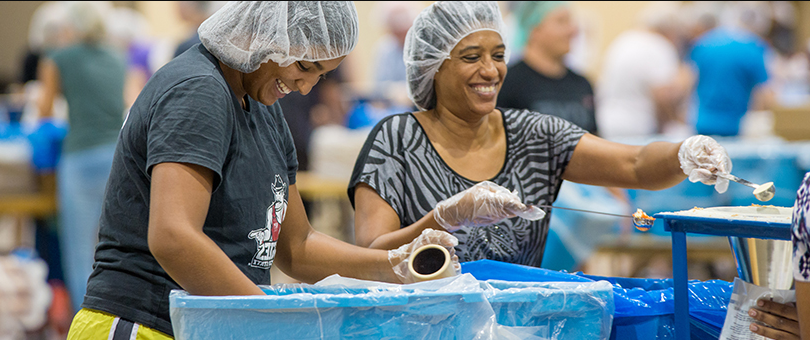
Volunteers pack meals at Feed My Starving Children. Photo courtesy of Feed My Starving Children
Give Smart: 6 Ways to Maximize Your Giving
A few tools let you give more without spending more. This is education, not tax advice, so check with your tax professional before you act.
Give appreciated shares through a donor-advised fund. If you itemize and you've held a stock or fund for more than a year, you can generally give the shares instead of cash, deduct their full market value, and never pay capital gains tax on the growth the shares have had since you bought them. This applies only to shares in a regular taxable brokerage account. Shares in an IRA or 401(k) don't get this benefit. For IRAs after 70½, see QCDs below. Many churches and smaller charities aren't set up to receive shares, though, and that's where a donor-advised fund helps. My wife and I use one. We contribute appreciated shares, take the deduction in the year we contribute, and then recommend grants to the charities we support on our own schedule. Several of our gifts go out every month. I explained the math, and why a donor-advised fund benefits both the giver and the charity, in Five Financial Decisions That Made My Downshift Possible. One tactic I like: when the market is down, sell losing positions to harvest the tax losses and then purchase similar but not identical shares. When it's up, give your biggest winners to the fund.
Bunch your giving. If you usually take the standard deduction, one strategy is to combine two or three years of gifts into one year, itemize that year, and take the standard deduction in the others. A donor-advised fund makes this easy, because you get the deduction now but can make the gifts in future years, so the charities still receive a steady level of support.
Know the 2026 rule changes. The 2025 tax law changed charitable giving starting this year and carrying into next year:
If you take the standard deduction: you can now deduct up to $1,000 in cash gifts, or $2,000 if you're married filing jointly. The gift must go directly to a qualifying public charity. Gifts to a donor-advised fund don't count.
If you itemize: only the giving above 0.5 percent of your adjusted gross income is deductible. On a $200,000 income, the first $1,000 of giving no longer reduces your taxes. Bunching helps you clear that floor.
If you're in the top tax bracket: the benefit of itemized deductions is capped at 35 percent.
Use a high-income year. If you're facing a year with unusually high income, like a business sale, a large bonus, a big stock vesting, or your last full year of salary before you downshift, front-loading a donor-advised fund can give you a bigger deduction when you need it most, and you can grant the money out over the years that follow. We did that this year to cover the first few years of our downshift.
Watch the fees. Giving by credit card earns you points, which can be attractive, but charities typically pay around 2 to 3 percent in processing fees, so part of your gift goes to the card company. A bank transfer (ACH) or a grant from a donor-advised fund sends more to the cause. You can also often check the box to cover the processing fees while racking up points for a future adventure.
After 70½, look at QCDs. A qualified charitable distribution lets you give directly from your IRA to a charity. The money isn't counted as taxable income, it can count toward your required minimum distribution once those begin, and it isn't affected by the new 0.5 percent floor.
Giving after the paycheck stops
Once you retire, a percentage gets trickier. Ten percent of what? Some retirees give a percentage of what they withdraw each year. Others give a percentage of their spending, or they set a fixed annual amount in their plan the same way they'd budget for travel. The key is to build giving into your retirement spending plan from the start, so it never feels like it competes with your security.
For people of faith, there's a wrinkle. If you tithed on your gross pay while you were working, including the dollars that went into your 401(k), do you give on the growth only or the full withdrawal? Thoughtful people come to different answers. I'm working through it myself.
So What's in It for You? Why Give?
Think about the kindest, most generous person you know, at work, in your neighborhood, or in your circle of friends. When you talk with them, they take a real interest in you. You never get the sense they're just waiting for their turn to talk. They care about you for who you are, with no angle and no agenda. Part of giving is becoming a little more like that person. The habits and attitudes we practice shape us, over time, into the people we want to be.
Here's what I've learned: giving is the antidote to ego, selfishness, pride, and hoarding. When we loosen our grip on our time, talent, and treasure, we learn to let go and trust that we'll have enough. We become more generous-hearted and more willing to listen. We don't give in order to become better people, but over time we become givers more than takers. The world needs more of that. And giving makes us more content, happier people, too. I’ll admit something I can’t fully explain. Over the years, the more we’ve given, the more our net worth has grown. Part of it is probably practical, since deciding what to give each year forced us to plan, budget, and spend with intention. But that’s not why we give, and I’d never promise it to anyone.
Research backs this up. A study of more than 200,000 people across 136 countries found that people who had given to charity in the past month were more satisfied with their lives, by about as much as if their household income had doubled. And for those of us in the second half, a review of studies on adults 55 and older found that volunteers had a 24 percent lower risk of death, even after accounting for health.
Your why may be different. Maybe it's gratitude for what you've been given, the people who carried you through a hard season, or simply the kind of person you want to become. For me, it starts with faith.
Let me get personal for a moment, especially if you're faith-curious or already a person of faith. I believe God is a giver first, and everything I have is on loan. Psalm 50 says the cattle on a thousand hills belong to Him, so He doesn't need our money. He wants our hearts. The apostle Paul wrote that each of us should give as we've decided in our hearts, "not reluctantly or under compulsion, for God loves a cheerful giver." That's why there's no guilt in this post. When I give, I'm reflecting, in a small way, the heart of the One who gave first. Loving God and loving people is the heart of giving.
A Few Final Thoughts
I don't know what those couples gave up to be there for us the way they did in 2009. Some of those evenings probably cost them more than we knew, and I'm sure it was emotionally tough to watch a young couple go through hard times on multiple fronts. But I know what their generosity meant to us, and I know it changed what I want to be for someone else.
We all hope to have friends like that in a hard season. Giving is how we become them.
One step this week: Pick one way to give before Giving Tuesday on December 1. Sign up for a volunteer shift, call a friend who's in a hard season, set up an automatic monthly gift, or move appreciated shares into a donor-advised fund. Small is fine. The point is to begin. And if you've been giving for a while, check whether the organizations you support and the amounts you give still fit what you want to do in 2027. Like reviewing your asset allocation and net worth at year end, this belongs on our annual checklist.
Let's make wise choices and live a great life together.
🌵 Desert FI
Want to go deeper?
Desert FI Insiders get Weekend Reflections, the Well-Timed Exit Checklist, the FINE Number Calculator, and reflection guides for every stage of the journey. If you're not on the trail with us yet, join at https://www.desertfi.org/join
Already an Insider? Here are three posts worth exploring:
Don't Leave It in the Field: An Open Enrollment Guide for an Earlier Exit, on gathering every benefit you've been given before the season changes
Six Things I Wish My 45-Year-Old Self Had Known, on the lessons I'd hand my younger self about money, work, and time
How FI Led Me to FINE: A New Way to Think About the Second Half of Life, on why financial independence was never the finish line
Sources
Leviticus 19:9-10 and Psalm 50:10 (ESV), on gleaning and the cattle on a thousand hills
2 Corinthians 9:7 (ESV), "…not reluctantly or under compulsion, for God loves a cheerful giver"
Stephen R. Covey, The 7 Habits of Highly Effective People (1989), Habit 3: “Put First Things First”; the “big rocks” illustration appears in Covey, A. Roger Merrill, and Rebecca R. Merrill, First Things First (1994)
Aknin et al., “Prosocial Spending and Well-Being: Cross-Cultural Evidence for a Psychological Universal,” Journal of Personality and Social Psychology, 2013: https://cpbl.sci.mcgill.ca/publications/Aknin-et-al-JPSP2013-prosocial-spending-happiness-with-appendix.pdf
Okun, Yeung, and Brown, “Volunteering by Older Adults and Risk of Mortality: A Meta-Analysis,” Psychology and Aging, 2013: https://keep.lib.asu.edu/items/129666
Kiplinger, "3 Major Changes to the 2026 Charitable Deduction": https://kiplinger.com/taxes/major-changes-to-the-charitable-deduction
Giving What We Can 10% Pledge: https://www.givingwhatwecan.org/pledge
Charity Navigator: https://www.charitynavigator.org
ECFA: https://www.ecfa.org