The Harder Trail: Why FINE is the Adventure Worth Taking

I was at a client conference in the desert last spring, the kind where the days are structured within an inch of their lives and the evenings are fire pits and industry conversation. I genuinely enjoy those events. The thought leadership is real, the relationships matter, and there is something about a few days away from the normal rhythms that resets my thinking.
But by midweek I had no more work talk left in me.
I was sitting in a breakout session, colorful slides on the screen, water being poured around tablecloth-lined tables, a temporary wall between us and the hum of another session next door. Good content. The right people. And I was somewhere else entirely.
That afternoon we had a long recreation break scheduled. My colleagues headed to the golf course, the giant resort pool, a spring training game. All reasonable choices. I drove fifteen minutes into the Sonoran Desert and planned a simple loop. Sixty to seventy-five minutes. Gentle ups and downs. Enough to get the blood moving and clear the accumulation of three days of industry conversation. I had emails to catch up on. I needed to be back for the evening reception. I had planned something responsible and efficient and contained.
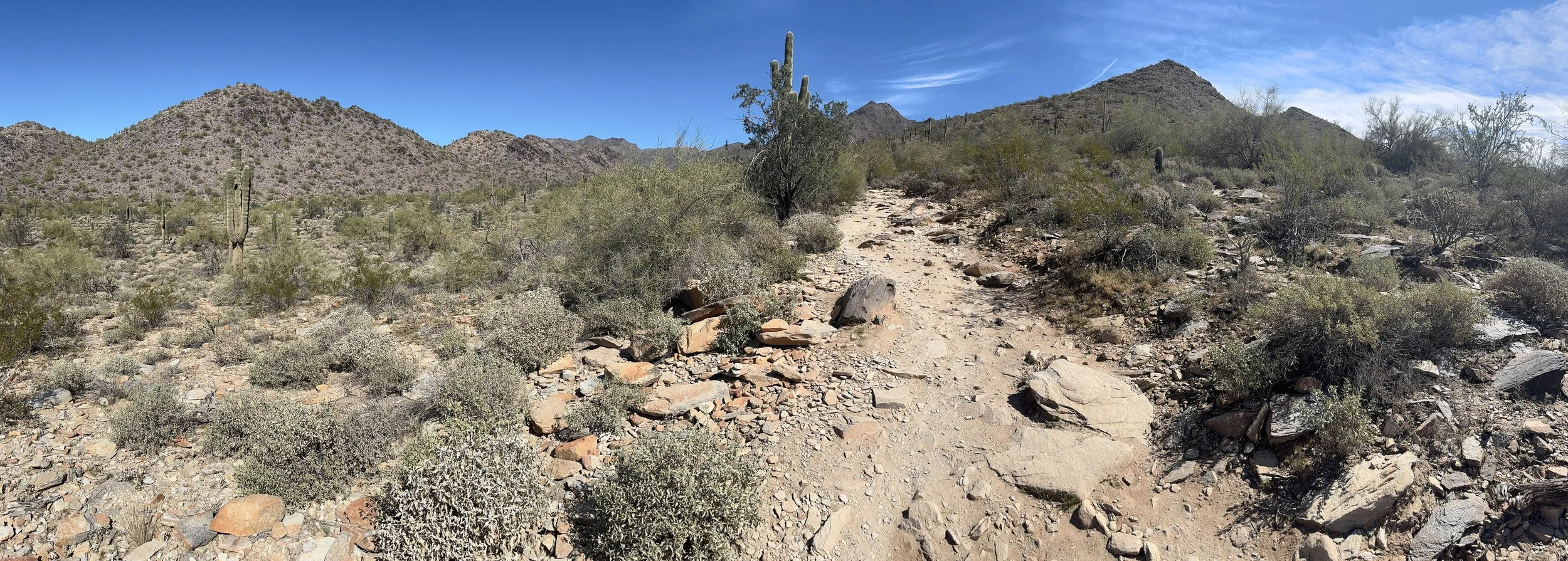
About twenty minutes in, I saw a trail shooting straight up the ridge. Steep incline. Sharp switchbacks. Towering saguaro silhouetted against a sky that had no business being that blue on a weekday afternoon.
It looked harder and more interesting.
I stood at that fork longer than I should have. The emails. The reception. The professional obligation to be present and available. I had spent thirty years getting very good at fitting adventure into a neat little box with a lid.
And then I thought about Jon.
Jon was an Eagle Scout from a Southern city, great sense of humor, drove an orange 1967 Ford Mustang. He showed up at my dorm room the afternoon before Reading Day once and told me we were going hiking. I told him there was six inches of snow on the ground and it was still snowing hard. He would not take no for an answer. So I packed a frame pack with ramen, a camp stove, a sleeping bag, and fire gear, and we loaded into that Mustang and drove through back county roads toward the Blue Ridge Mountains, his wheels slipping a little with every turn. The beer was Rolling Rock. I can still see the fire glinting red off the bright green bottles as we sat in knee-deep snow a few weeks before Christmas, staring at the stars, celebrating youth and freedom and being completely, gloriously out of the plan.
I had not done anything like that in a long time.
I left the safe responsible loop at the trailhead and took the harder trail.
What was supposed to be seventy-five minutes turned into two and a half hours. On the way down, legs shaking, heart beginning to slow, I stopped and looked out over the valley below me. Not a resort in sight. Just open desert stretching as far as I could see: saguaro and cholla and teddy bear cacti forming green dots and blurs across tan earth, dry washes cutting through the landscape, the whole wild Sonoran world going quietly about its business.
My heart was full in a way it had not been in a while.
Standing there on shaking legs, a thought arrived that I had been approaching for years without quite naming:
Some paths are harder now but lead to a much more meaningful second half of life.
This post is about that path. And the math, the stories, and the philosophy behind why it might be the best decision you make, whether you are in your thirties building toward it, your forties accelerating toward it, or your fifties standing at the trailhead deciding which way to go.
The Easy Loop vs. The Harder Trail
Most of us are offered two default paths for the second half of life, and neither one quite fits.
The easy loop is traditional retirement: work until 65, then stop. Pickleball, golf, the beach. Comfortable, predictable, familiar. Nothing wrong with it. But for a certain kind of person, the one who is not ready to stop contributing on their own terms, it can feel like stopping in the middle of a sentence.
And then there is FIRE, the path that trades decades of working for decades of extreme frugality. For some people that trade makes sense. For many it does not.
The harder trail is something different. It means pursuing what I call a Next Endeavor: staying mentally sharp, using gifts you spent decades developing, and contributing in ways that actually matter. It is not retirement from life. It is retirement from the wrong work.
The tension is simple: comfort versus calling. Ease versus meaning. Escape versus contribution.
FINE, Financial Independence, Next Endeavor, lives on the harder trail. The one that requires more of you but leads somewhere better. I wrote about how I discovered FINE and what it means in practice in How FI Led Me to FINE.
The Problem: Most People Do Not Want FIRE
A few numbers worth sitting with, from Vanguard, Fidelity, and the Federal Reserve.
The median 401K balance for Americans in their fifties ranges from $68,000 to $96,000, far short of what most people need. The average personal savings rate is 7.7%. Thirty-six percent of non-retired Americans have nothing saved for retirement. Only 14% of workers max out their 401K.
Most people cannot save 35 to 50% of their income to reach FIRE. And if they are honest, many do not want to retire at 40 and never work again.
They do not want traditional retirement. They do not want FIRE. They want FINE.
But there is a harder truth underneath the FIRE math that does not get discussed enough. A committed FIRE saver on $100K income puts away 35% annually, leaving $65,000 to live on during their working years and the same $65,000 in retirement. I will say plainly what the spreadsheet implies: most people reading this do not want that life. Not because $65,000 is not enough to survive on, but because the moments that matter cost more than survival. A meal out with old friends. A trip somewhere you have always wanted to go. Hobbies that require equipment and time and occasionally a flight. A wedding someday for a child. These are not luxuries. They are the texture of a life well lived, and $65,000 does not leave much room for any of it, especially when you factor in healthcare costs for twenty-five years before Medicare arrives.
FINE is the path that preserves that richness, at any income level, at any stage of the journey.
The Three Paths: Traditional vs. FIRE vs. FINE
To keep the comparison clean I am using a flat $100,000 income. In real life incomes rise over time, but the relationships between these paths stay consistent regardless of where you start. The principle scales whether you earn $60,000 or $200,000. What matters is the ratio and the timing, not the absolute number.
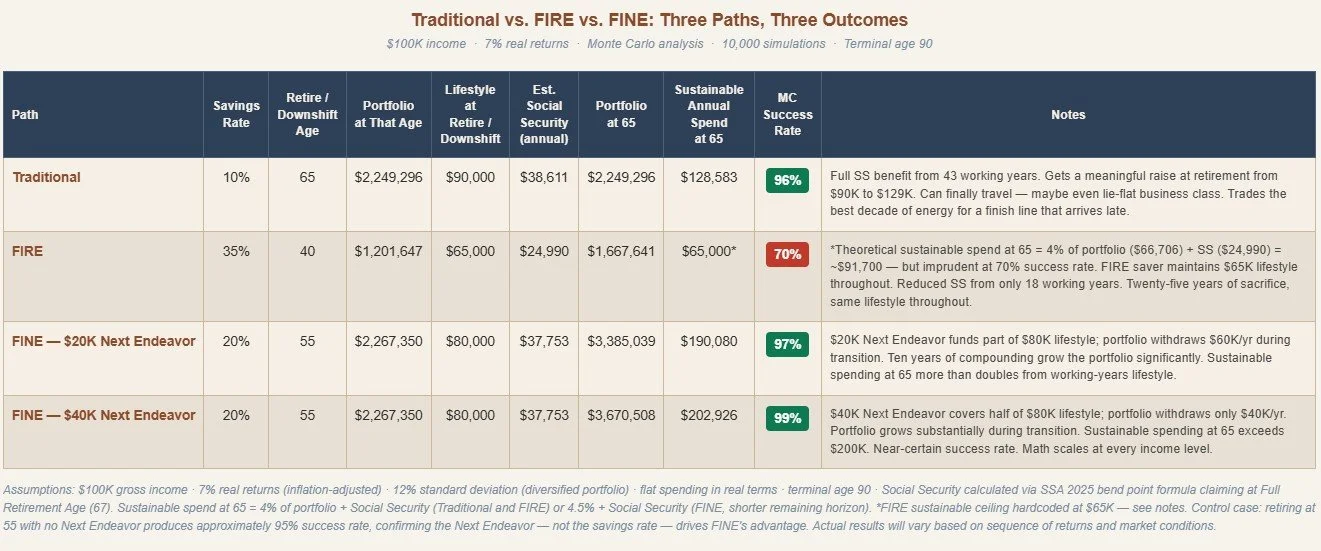
Here is what happens when three people earning the same income choose different paths.
What the Table Really Means
Traditional
The traditional saver works until 65, lives a normal life, and ends up with roughly $2 million. Because Social Security covers a meaningful portion of their spending, they get something close to a raise in retirement. They can finally travel, maybe even splurge on lie-flat business class once or twice. But they are in the ninth inning of life. They traded ten years of energy, freedom, and adventure for a finish line that arrives late.
By Contrast, FIRE
The FIRE saver reaches their number at 40 but only by living on $65,000 for the rest of their life. They also accumulate a much smaller Social Security benefit because they worked for only about eighteen years. From 40 to 65 they withdraw the $65,000 they are accustomed to. By age 65 their nest egg has grown to roughly $1.7 million, but do not be fooled by that number. Social Security at 67 adds approximately $25,000 per year. The theoretical 4% sustainable spending from their portfolio plus Social Security approaches $92,000, but spending that amount would be imprudent at a 70% success rate. The wise FIRE saver maintains their $65,000 lifestyle and accepts that twenty-five years of sacrifice produced the same lifestyle they would have had anyway. And this math does not include healthcare costs. Without employer coverage or Medicare for twenty-five years, a FIRE retiree faces significant additional expenses that compress the $65,000 lifestyle further. Mathematically possible. Emotionally and financially fragile. And a long time to live on the same amount you earned during your working years.
FINE Example 1: Earn $20K in a Next Endeavor
The FINE saver downshifts at 55, earns $20,000 doing something meaningful, and only needs to withdraw $60,000 from their portfolio during the transition years. Their portfolio still grows, ending at approximately $3.4 million by age 65. At 65 sustainable spending reaches approximately $190,000 including Social Security, more than double their working years lifestyle of $80,000. The go-go years arrive well-funded. This is the power of avoiding large early withdrawals and giving your money ten extra years to grow.
FINE Example 2: Earn $40K from Next
FINE Example 2 shows what happens when your Next Endeavor covers half your spending needs. At $40,000 in Next Endeavor income against $80,000 in lifestyle spending, the portfolio withdraws only $40,000 per year during the transition rather than $60,000. That $20,000 difference compounds quietly for ten years. The portfolio reaches approximately $3.7 million by 65 and sustainable spending approaches $203,000 including Social Security. Every dollar your Next Endeavor earns is a dollar your portfolio does not have to provide, and a dollar that keeps compounding instead.
The punchline: FINE gives you back ten years of compounding, the decade where money doubles, while letting you live on two to three times the FIRE lifestyle. And unlike traditional retirement, you do not have to wait until 65 to start living it.
Real Stories From the FINE Trail
The math makes the case. But math does not change how people think about their lives. Stories do.
My Dad
My father was a Marine Corps veteran who built a second career as a magazine writer and eventually editor-in-chief of a defense periodical. He loved writing. He did not love office politics, someone else's deadlines, or decisions made by people with less experience and more authority than him.
When a new boss arrived with ideas that were not grounded in reality, my dad did the math quietly. He had a military pension. Social Security was a few years away. He had built enough relationships to believe the work would follow him. One June, he decided he was done.
The change was immediate. He rediscovered his joy for writing, for interviewing, for doing his own editing on his own terms. I noticed it at Thanksgiving that year. He smiled more. He laughed more easily. There was a lightness about him that made him seem years younger. He had been carrying the weight of misalignment for longer than any of us realized, and setting it down changed his whole countenance.
At first he took most of the work offered to him. Over time he became more selective, choosing subjects that genuinely interested him or topics he thought would challenge his mind. He wrote not just for defense publications but for Vanity Fair and Newsweek. He had attended the Paris Air Show many times on a press pass during his career. In retirement he went back as a freelancer, purely for the joy of it, planning to write a few articles for whoever wanted to buy them. They did.
He built a life around seasons rather than schedules. He lived almost three decades after stepping away from full-time work and did at least some writing until the last few years of his life.
That is FINE.
Jenny
A friend from a city we used to live in had always been entrepreneurial. While raising her family she had built a small business selling fashion accessories to friends and acquaintances, turning relationships and genuine enthusiasm into income. When her husband retired from banking, she turned that same energy toward something she had always loved: travel.
She became a travel planner, helping friends arrange trips to Europe, the Caribbean, and beyond. Before, I would see photographs from their vacations: cruises, beach trips, comfortable familiar destinations. After she became a travel planner, the photographs changed. Greece. Italy. Mediterranean luxury lines. She was traveling more, seeing more, going further, partly to serve her clients better and partly because the work gave her license to pursue the adventures she had always wanted. She got better rates on flights and hotels. She lit up talking about helping people create memories.
That is FINE.
Betty
Betty goes to my church. She is probably in her late seventies or early eighties, one of those genuinely warm people whose kindness you feel the moment you are in a room with her.
I met her in a small informal group that formed after a personal finance class a friend and I teach at church. People were sharing honestly about their challenges, asking questions they had not felt safe asking before. I was not expecting to hear from someone so late in life still struggling with the basics.
Betty cried telling us her story. She was taking on a small amount of new debt every month because a single meager Social Security payment was not enough to live on. The math was simple and brutal: she was slowly running out.
She had spent much of her life sewing. Custom curtains. Even wedding dresses. She was skilled in a way that takes decades to develop. But her body had changed and she could no longer get down on her knees to cut and pin curtain fabric on the floor. The work she had always done was no longer available to her in the form she had always done it.
So we talked about what she could do instead of what she used to do. Quilts. Baby blankets. Afghans. Custom decorative pieces, placemats and table runners, the kinds of things people buy at craft shows because they are beautiful and made by someone who cares. She started at our church Christmas bazaar. The last I heard, she was doing several home shows and craft expos a year.
The income has added somewhere between $10,000 and $20,000 annually. She has paid down her debt. She earns more than she spends now. She has more restful nights and less anxiety about the future.
But what I remember most is that she got her dignity back.
That is FINE.
Why the Harder Trail Is Worth It
FINE is not the right path for everyone. If traditional retirement genuinely appeals to you, if the pickleball and the beach and the unhurried mornings are what you have been building toward, that is a legitimate and worthy answer to the question of what comes next. This post is for the people who feel something unfinished when they imagine that version of the future. The ones who suspect they have more to contribute and want to do it on their own terms.
For those people, FINE gives you meaning and margin, the breathing room to make decisions from clarity rather than fear. It gives you flexibility and freedom. It gives you a chance to contribute in ways that matter. And it keeps you sharp, engaged, and building wealth, often more than either Traditional or FIRE.
You do not have to retire from life to retire from the wrong work.
I have been hiking alone since the early days of the pandemic, when the family would go out together to get out of the house and then the next morning I would want to go back and they were sore and did not feel like it. Something about those first solo mornings changed me. Getting up at 5:30 in the morning and hitting the trail before the city woke up, watching colorful sunrises light up the wide open Arizona sky. I am a confirmed extrovert by every assessment I have ever taken. But somewhere on those early morning trails, I found a quieter part of myself I had not spent much time with. A part that needed solitude the way other parts needed collaboration and conversation.
The harder trail, financially and literally, does the same thing. It asks more of you. It does not follow a tidy schedule. But it takes you somewhere the easy loop cannot reach.
The Invitation
When I finally came back down that ridge, free time was just ending. I showered, put on my conference clothes, and walked out to the evening reception on a manicured lawn that abutted a raw desert mountain. The same Sonoran Desert I had just come from, now with string lights and passed appetizers and the comfortable hum of professional conversation.
I re-engaged. Talked with clients, colleagues, old friends. Re-energized in a way that surprised me.
On the way to the parking lot after my hike I had pulled a sprig of rosemary from a bush at the trailhead. The smell was still on my fingers at dinner. A small private thing. A reminder that I had, for a few hours on a weekday afternoon, done exactly what I want to do more of when the calendar finally belongs to me.
A stolen taste of a future still being planned and yet unseen.
That is what FINE offers. Not a destination. A direction. And sometimes on a desert trail with shaking legs and a full heart, looking out over a valley that does not know your name, the direction becomes very clear.
If you are in your thirties building toward financial independence, FINE is the path that gets you there without the austerity of extreme early retirement. If you are in your forties accelerating toward the exit, FINE is what makes the exit worth taking. If you are in your fifties standing at the trailhead deciding which way to go, the harder trail is right in front of you.
It requires more of you. It leads somewhere better.
Let’s take the harder trail together.
🌵Desert FI
Want to go deeper?
Become a Desert FI Insider. The harder trail is easier with company, and the math is easier with the right tools. Insiders get Weekend Reflections every Sunday morning plus free Insider-only resources, including a Monte Carlo calculator you can run on your own numbers. If you’re not on the trail with us yet, join at DesertFI.org/join.
Already an Insider? Here are three posts worth exploring:
The Sequence That Determines Whether Your Retirement Lasts: on sequence of returns risk and how to protect against it
Not the Lattes. Here’s What Actually Retires You Early.: on the decisions that build your exit
Landing the Plane, Part 1: Building Your Drawdown Framework: on turning the numbers into a plan you can live on
Geek Out Corner
For readers who like to see the numbers, here are the Monte Carlo outcomes using randomized historic market returns.
Traditional: approximately 96% success rate.
FIRE: approximately 70% success rate. Despite a growing portfolio at 65, the fifty-year withdrawal horizon and small Social Security benefit make this the most fragile path.
FINE $20K Next Endeavor: approximately 97% success rate.
FINE $40K Next Endeavor: approximately 99% success rate.
Key Question:
Was the improvement simply because the savings rate doubled? No. If someone saved 20% but fully retired at 55 with no Next Endeavor, their success rate would be approximately 95%. With a $20K Next Endeavor (FINE Example 1), success reaches 97%. With a $40K Next Endeavor (FINE Example 2), success reaches 99%. The control case is critical: the improvement comes from the Next Endeavor itself, not from saving more.
Bottom Line: It is not the savings rate that makes FINE so effective. It is the Next Endeavor itself. Avoiding early withdrawals is the real engine of FINE.