The Sequence That Determines Whether Your Retirement Lasts (And How to Sleep Through the Chaos)

Hidden Lake, Glacier National Park. The payoff for building a plan that can ride out the peaks and valleys.
I can still remember the buzz in the air as companies flocked to our business school to recruit. Sharp-suited presenters in lecture halls, case competitions to see who rose to the top, cocktail parties designed to test your social graces, and interviews designed to show not just what you had done but how you think. By the time graduation rolled around in May 2007, I had multiple offers and accepted the one that felt like exactly where I was supposed to be, in a growing Southeastern city, learning operations and generating revenue with the sky apparently the limit on where my career was heading.
You know what came next.
First came the dark clouds of mortgage failures, the revelation of no-doc liars loans where people received mortgages at inflated values with little documentation of their income, assets, or credit worthiness.
By the fall of 2008, Lehman Brothers was gone and the financial system was in genuine freefall.
The city I was working in was banking-centric, deeply connected to the investment markets, and the sound of that unraveling was not abstract background noise. I would see people with file boxes walking out of high-rise towers, tears in their eyes. Vacancy signs appeared as firms went bankrupt and building owners scrambled to backfill. The restaurants that had once been bustling with waitlists and full bars sat empty, shadows of their former selves. Many went under within months as survival, not thriving, became the measure of success.
I eventually was not immune. While I was not directly working in banking at the time, my industry was decimated by the credit markets freezing up, and the project I had been hired to work on disappeared overnight, along with most of my firm's employees. Like many of my business school classmates, I was suddenly unemployed for the first time in my life, with a two-year-old at home and a mortgage to cover every month. I wrote about some of the lean seasons that followed, including a three-digit checking account balance and my wife biking our son around in a trailer while I chased clients before dawn, in Cutting the Ankle Weights. If you want the fuller story of what that season cost and what it eventually clarified, The Gilded Cage goes there. It was humbling to say the least.
That experience burned something into my understanding of markets that no finance classroom ever had. Numbers on a screen are easy to process. Watching a portfolio drop 40% while you still have to pay your mortgage is something else entirely.
This post is about preparing for the worst, staring your deepest fears in the face, and developing a plan to weather them so that when the next pullback comes, and they always do, you have a framework built in times of lower emotion to help you through the storm.
The Math That Changes Everything
When you are in the building phase and saving for the future, most retirement planning tools let you enter an average annual return. Seven percent. Ten percent. Whatever your optimistic or conservative assumption is. The tool runs the math forward, shows you a projected balance at age 65 or 70, and leaves you feeling either relieved or anxious depending on the number. It is a genuinely valuable tool for that phase. Being able to adjust savings rate, investment returns, and retirement date helps you figure out what needs to be true for you to retire someday. I used it personally and found it enormously helpful in the early years of our financial independence journey.
However, as you get closer to landing the plane, or as you decide in your forties or fifties that you may not want to work as long or as intensely as you once assumed, here is what those tools do not tell you: your average return in the years surrounding retirement is almost irrelevant.
What determines whether your nest egg survives is not what the market returns on average over thirty years. It is the order in which those returns arrive. Specifically, whether the bad years come early or late.
This is called sequence of returns risk, or SORR, and it is the most underexplained concept in retirement planning. To illustrate it, meet two very different couples and see how the timing of early market returns shapes their lives in retirement. For each couple we will look at how these strategies would have changed their outcomes and what a more secure and more fulfilling retirement might have looked like.
Meet Jim and Karen
Jim and Karen had been together since high school, a retail store manager and a real estate agent who had lived carefully and saved consistently for thirty years. They were not flashy people. Their dream was simple: a trip to Europe, finally, in their first year of retirement. They had talked about it for decades. The folder sat on Karen's computer, full of hotel ideas, cities they had circled, and a rail pass route they had been refining for years.
They retired in January 2000 with $1,500,000 in liquid net worth, excluding the value of their home. They decided to follow the 4% rule. The 4% rule, developed by financial planner William Bengen in 1994, holds that withdrawing 4% of your portfolio in year one of retirement and adjusting for inflation each year gives you a high probability of never running out of money over a thirty-year horizon. Bengen has since revised his figure upward to 4.7% based on a broader historical data set, suggesting the original rule may be more conservative than necessary. Jim and Karen withdrew $60,000 in year one. By every conventional measure, their plan was solid.
Then the dot-com crash arrived. Then a partial recovery. Then 2008.
Here is what their portfolio actually looked like, year by year, following real S&P 500 returns:
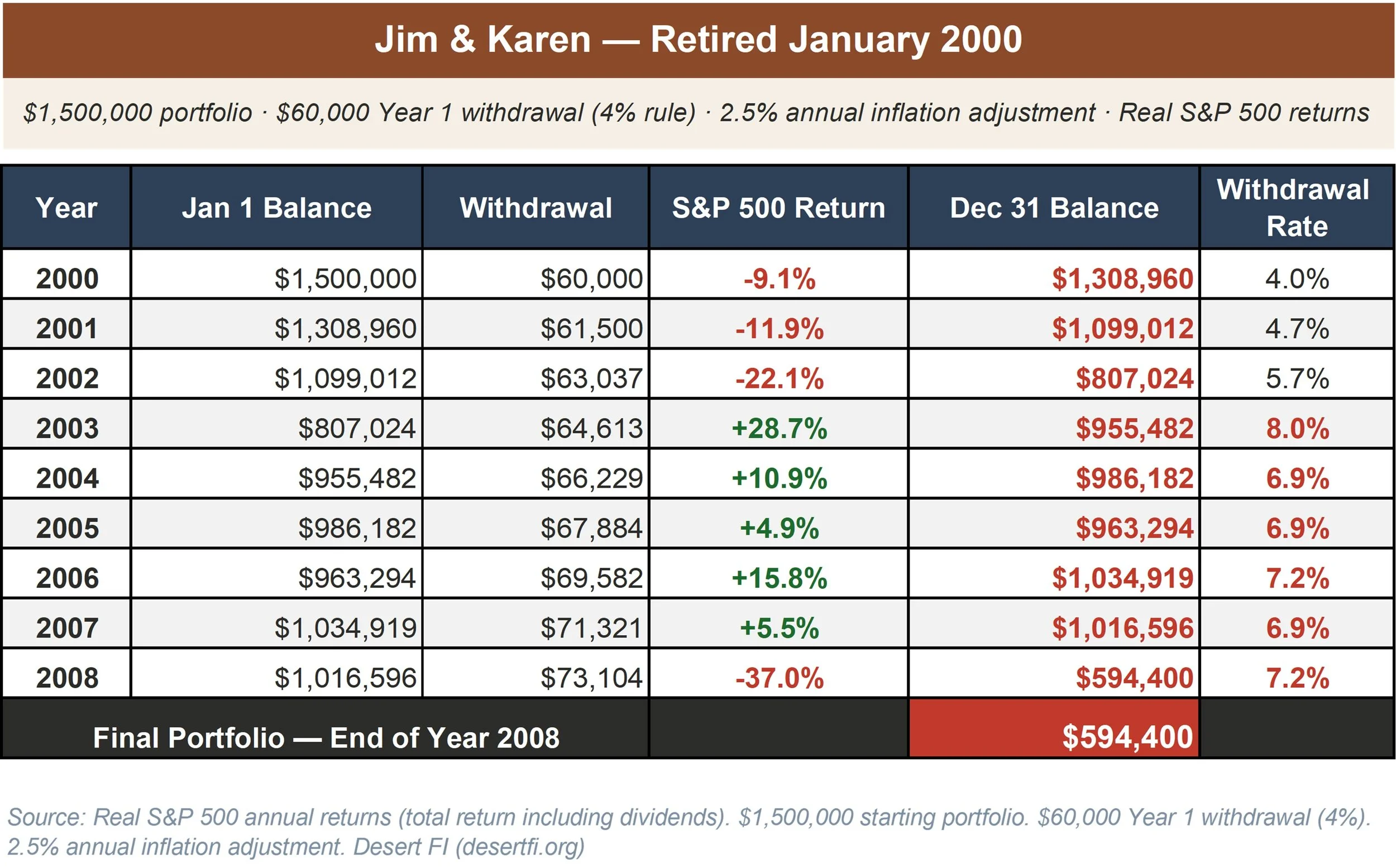
By the end of 2008, Jim and Karen had $594,400. They started with $1,500,000. They had lost more than 60% of their retirement savings following the rules correctly.
Their withdrawal rate, which started at a reasonable 4%, had climbed to 8% of a depleted portfolio by 2003 and stayed elevated for years. Every dollar they withdrew during those years sold assets at beaten-down prices, locking in losses permanently. The math that was supposed to protect them had turned against them.
The Europe folder sat on Karen's computer unopened. The trip they had talked about for thirty years became the first casualty of the spiral.
Yeah, But Every Year Is Not 2008
Fair. 2008 was one of the most severe market downturns in generations. You are not going to retire into two catastrophic bear markets in a single decade.
But here is the thing: you do not need 2008.
Last week I hiked in Montana, a trail rated intermediate by local standards. We descended steeply for a good hour, legs working hard against the grade, the trail dropping steadily below us. Then we rested and began the long climb back. What surprised me, even though I knew it intellectually, was how much longer and harder the uphill felt than the downhill had been. It reminded me of something I wrote in Fresh Tracks: the mountain rewards the ones who choose their line before the conditions choose it for them.
The math explains it. When you lose 40% of your portfolio, you need a 67% gain just to break even. A 20% loss requires a 25% gain to recover. The percentage recovery has to be larger than the percentage lost because you are now compounding from a smaller number. Every withdrawal you take during the decline makes that number smaller still, which means every subsequent gain has less to work with.
Any significant down sequence in the first decade of retirement creates the same dynamic at any scale. The dot-com crash alone, without 2008, would have done meaningful damage to a 2000 retiree. A 20% correction in years one and two of retirement is enough to permanently impair a portfolio that withdraws income every single year regardless of market conditions.
The SORR window is the first decade or so of retirement, whenever that decade begins. Every dollar withdrawn during that window at a depressed portfolio value does damage that subsequent good years cannot fully undo, because those subsequent good years are compounding on a smaller base.
Now Meet James and Keisha
James and Keisha had four decades of careful saving behind them. James worked in pharmaceutical sales for thirty years, building a career on relationships and trust. Keisha kept corporate networks running as an IT administrator, essential and steady work. They had funded college for their children, taken real vacations along the way, and arrived at retirement in their early sixties with a portfolio that reflected a life fully lived, not just aggressively optimized. While they had carefully planned against the downside, they had never seriously modeled the upside. What would they actually do if their portfolio ran meaningfully ahead of schedule? They had not asked the question.
They retired in January 2010, also with $1,500,000. Same withdrawal amount. Same inflation adjustments. Same 4% rule. They had the good fortune to retire into the post-crisis bull market rather than the crisis itself.
Here is what their portfolio looked like over the same nine years:
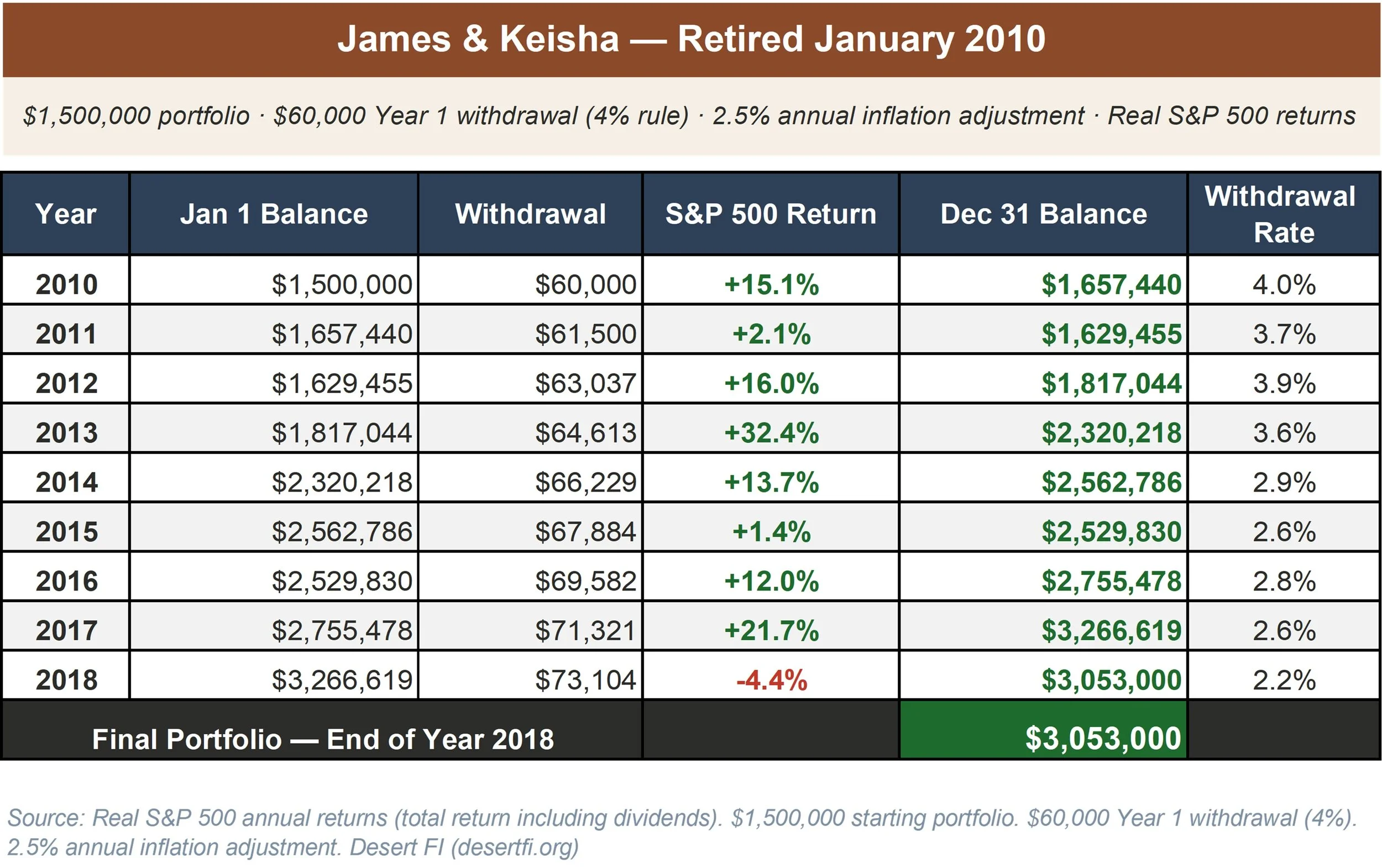
By the end of 2018: $3,053,000.
Jim and Karen: $594,400. James and Keisha: $3,053,000.
Same starting portfolio. Same withdrawal discipline. Different decade.
That $2,458,600 gap did not exist because James and Keisha were smarter or more disciplined. It existed because the market happened to give them their good years first.
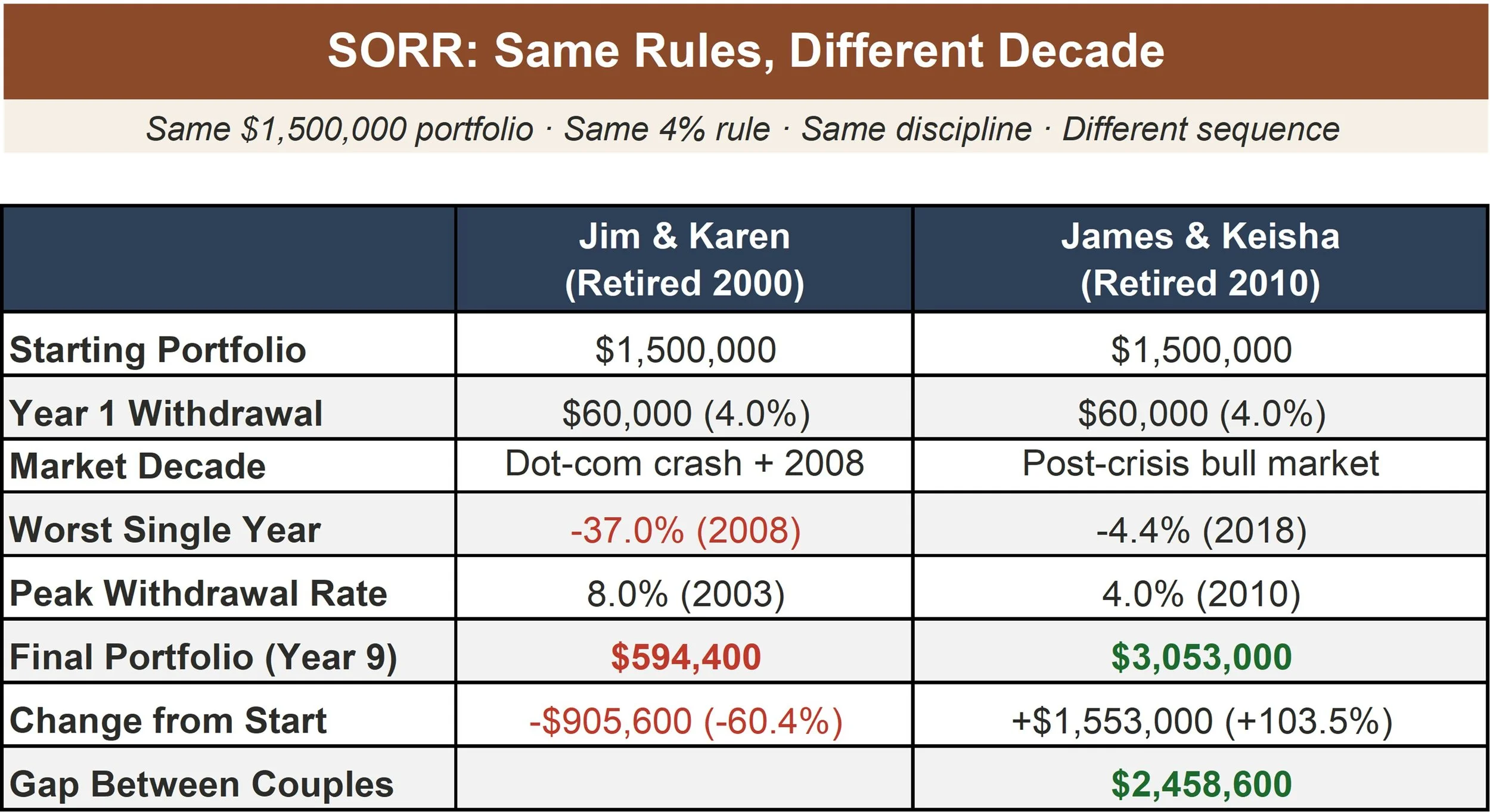
Jim and Karen's story is not a cautionary tale about poor saving or bad decisions. They did almost everything right. Their story is a cautionary tale about timing. And since none of us gets to choose which decade we retire into, the question worth asking is: what can you actually do about it?
Here are three things that work.
Three Things That Actually Help
Protection One: The Three Bucket Strategy
The core problem SORR creates is that a retiree facing a market downturn is forced to sell assets at depressed prices just to cover living expenses. Every forced sale in a down market locks in losses that compounding can never fully reverse.
The bucket strategy addresses this by separating retirement assets by time horizon so that a down market never forces a sale.
Bucket one is cash, high-yield savings, and short-term treasuries. This covers near-term living expenses without touching the market at all. When the market drops, you spend from this bucket and leave everything else alone.
Bucket two is short-term bonds with maturities staggered over the next several years. A note on implementation: I hold individual government bonds rather than a bond fund, specifically because bond funds can lose value when interest rates rise. Individual bonds held to maturity return their full face value regardless of what rates do in the meantime, which makes bucket two a more reliable bridge than a fund that could drop in value at exactly the wrong moment.
Bucket three is equities, long-term growth, the engine of the plan. You do not touch bucket three in a down market. You let it recover. By the time you need to draw from it, the downturn has had time to pass.
When bucket one runs low at the end of each year, the decision is straightforward. If the market is up, you replenish from appreciated equities and roll over bonds to keep bucket two full. If it is down, you replenish from maturing bonds and leave equities alone entirely. If it is flat or slightly up, you can use a mix of both. Distributing next year's spending this way also keeps you closer to your target equity and fixed income allocation.
Outside the three buckets entirely, I maintain a fourth optional bucket, what I call a Life Fund. It sits at my primary bank in savings, earning less than the yield I could get elsewhere. I do not care. I smile every time I log in and see it there.
The Life Fund is not optimized. It is earmarked. It holds roughly four to six months of reserves outside the bucket system entirely, set aside for the irregular large expenses that do not fit neatly into annual spending plans: a trip I have been thinking about for the week after I leave full-time work, the sale on airfare to New Zealand that does not wait for a convenient moment, a car replacement when the kayaks and paddleboards finally justify a truck, the HVAC system that fails in August. Keeping it separate means the bucket math stays clean. I can say yes to the New Zealand fare without recalculating anything.
It also serves as a calibration buffer in the early years of retirement. If I have misestimated our spending, which is possible even with a careful model, the Life Fund gives us time to adjust without touching the investment portfolio. Consider it the financial equivalent of building in a little extra margin before the bridge.
One additional note: several popular FI writers and podcasters have recently advocated for a Risk Parity strategy in place of the three-bucket approach. I have added a brief note on this in the Geek Out Corner at the bottom for those who want to explore it.
Protection Two: The Next Endeavor
I have written about this in depth in Why $20K a Year Changes the Retirement Math More Than You Think and The Harder Trail, so I will be brief here. For readers new to Desert FI, Financial Independence, Next Endeavor (FINE) is the concept of meaningful, flexible work you genuinely want to do in the years before full retirement: the consulting practice, the teaching, the creative work, the thing you have been wanting to do more of. The full philosophy is in How FI Led Me to FINE.
A generation ago, a pension did for retirees exactly what SORR protection requires: it provided income starting the day you stopped working and running until you died, meaning the portfolio never faced full withdrawal pressure during the most dangerous years. Nobody had to sell stocks in 2001 or 2008 to pay their mortgage if they had a pension.
Almost nobody has a pension anymore. But the mathematical need for that bridge has not disappeared.
A modest Next Endeavor fills exactly that role. If Jim and Karen had generated even $20,000 in year one from a Next Endeavor, ramping gradually as their work found its footing, they would have needed $40,000 from the portfolio instead of $60,000 during the most dangerous years. That difference, compounded through the recovery, changes their outcome materially.
The Next Endeavor is not a backup plan. It is the closest thing to a manufactured pension that the modern retirement landscape offers.
Protection Three: Financial Guardrails
The bucket strategy and the Next Endeavor are proactive. They reduce the damage before it happens. Guardrails are reactive. They give you a pre-built framework for responding intelligently when the market makes things difficult, rather than making expensive emotional decisions under pressure.
I have refined mine over the past several months and I would encourage you to similarly test your own to see which provide the best protection and which you can actually commit to and stick with. I check mine annually around New Year's and review a few quarterly.
Here is how I think about them, in plain language.

Guardrail 1: Skip the Inflation Adjustment
In any year following a negative market return, skip the annual inflation adjustment on spending. This does not require a spending cut at all. It simply means forgoing a modest upward adjustment. Most retirement models assume spending increases every year by CPI. Skipping that adjustment in a down year meaningfully reduces portfolio pressure in exactly the conditions when pressure is highest, and it stays active even when other guardrails are triggered. The analogy during your savings years is choosing to direct a merit increase to retirement savings rather than spending. Small behavioral change, meaningful long-term impact.
Guardrail 2: Severe Market Response
After two consecutive down years or a significant single-year correction, reduce total spending by roughly 10%. In practical terms, this might mean cutting the travel budget by one quarter to one half alongside trimming other discretionary expenses such as club memberships, dining out, and personal services. Last week, Mrs. Desert FI and I snuck away one afternoon for high tea at the historic Prince of Wales Hotel above Waterton Lake, a Canadian sister park to Glacier. Tiered trays, finger sandwiches, the kind of unhurried afternoon that does not happen often enough. That is the Upside version. Under our normal target spending, we stayed at a Hilton the night before a full park day: comfortable, well-located, not extravagant. Under Guardrail 2, maybe it is a well-reviewed local inn or a further drive from the park entrance. Half the price, same awe-inspiring vistas, same mountain goats on the snowfield above us, same memory made.
The guardrail adjusts the lodging. It does not adjust the life.
Guardrail 3: Portfolio Floor Response
This one was not fun to think about and even less fun to model. But when I did a deep dive on the small percentage of Monte Carlo scenarios that ended in portfolio failure, one of the biggest common denominators was a significant portfolio drop combined with spending that continued at the same level. The portfolio never got a chance to recover because the withdrawals kept coming at full rate while the base kept shrinking.
If real portfolio value falls approximately 40% below the starting level, this guardrail activates a meaningful response on two fronts simultaneously: strong spending adjustments and maximum Next Endeavor activation. No longer about ten to twenty hours a week with no Mondays, no Fridays, and the flexibility for a mid-day pickleball game or an afternoon hike. At this threshold it means choosing work I would prefer not to do, perhaps corporate consulting at a pace that competes with how I want to live, until the storm has been weathered and the portfolio has recovered enough to release the guardrail.
This is also when a HELOC on a paid-off home becomes a useful backstop, providing short-term liquidity without forcing equity sales at distressed prices.
Guardrail 4: Break Glass
This guardrail came out of studying lost decades in market history, including a prolonged period in the 1960s where U.S. equity returns were essentially flat for years at a time. Modeling it forced me to think seriously about what I would actually do if it happened.
The honest answer: I would not go back to full-time corporate work unless there was genuinely no other option. And I would not stop exploring this big beautiful world. God put in me the heart of an adventurer and I intend to answer that call regardless of what the market does. Glamping works. A pop-up trailer works. A hotel with running water is my wife's strong preference and mine too. But if the worst happened, we would find a way and we would still find wonder.
In addition to the spending and income adjustments this guardrail triggers, I also increased international equity exposure in response to this scenario. That was genuinely uncomfortable for someone who has been primarily a U.S. equity investor for thirty years. But modeling a lost decade in domestic markets specifically exposed a concentration risk I wanted to address before I needed to.
If real portfolio value falls approximately 60% below the starting level, this guardrail activates. In my own Monte Carlo model, it triggers in only a very small fraction of simulations, roughly in the same neighborhood as the overall plan failure rate. It exists not because it is likely but because having it pre-built means that if we ever approach it, we respond with a plan rather than panic.
Guardrail 5: Upside Permission
This one runs in the other direction and I think it is one of the most underwritten guardrails in retirement planning.
James and Keisha had spent decades planning carefully against the downside. What they had never seriously modeled was the upside. What would they actually do if their portfolio ran meaningfully ahead of schedule? They had not asked the question. When it happened, they had no framework for it. More money than expected sat in accounts without a plan, slowly accumulating without intention.
Guardrail 5 gave them one.
If the portfolio runs meaningfully ahead of where it started, pre-authorize yourself to spend more and give more. Not recklessly. With intention and proportion. The parable of the man who tears down his barns to build bigger ones and hoards everything for himself is a useful warning. Dying with more than you needed while giving less and loving less generously than you could have is its own kind of miscalculation.
My plan has a specific trigger for this. When portfolio value is meaningfully above where it started, spending can proportionately increase, with giving percentages increasing alongside it. We have capped future spending at our current gross income level so lifestyle creep does not exceed our peak earning years. For James and Keisha, a better-than-expected net worth became an actionable plan, with permission to give and enjoy rather than just an anxiety-reducing number on a screen.
For James and Keisha that permission took a specific shape. Years of faithfully funding four college educations and building toward a comfortable retirement had left little margin for the giving they had always felt called to do. When Guardrail 5 told them their portfolio was running meaningfully ahead of schedule, they did not upgrade their travel. They made a decision they had been talking about for a decade: a self-funded service trip to Kenya, working with an organization building schools and providing access to clean water in communities where neither exists. They came home changed in ways beyond what the portfolio statement could measure. The parable of the bigger barns is not a warning against enjoyment. It is a warning against accumulation as an end in itself. Guardrail 5 is what keeps the growing portfolio in service of a growing life, not just a growing number.
The Logic Is Universal, The Numbers Are Personal
Every threshold I have gestured at in the guardrail section is calibrated to our household. Your numbers will be different depending on your portfolio size, spending level, other income sources, and risk tolerance.
A fee-only CFP on a project basis can help you build your own guardrail framework. If you prefer a self-directed option first, subscription-based tools like Boldin or Pralana Gold put a CFP-caliber modeling environment in your hands to experiment with before that conversation. Either way, I would encourage running a Monte Carlo model with the guardrails actually modeled rather than just a fixed withdrawal assumption. The difference in outcomes is significant and it gives you genuine confidence that the plan holds under stress.
If you are experienced with AI tools, they can also serve as a useful thought partner for building a robust model, provided you approach it with clear and detailed direction. Specify the number of simulations you want to run, 10,000 is a reasonable baseline, request historical market returns rather than a single fixed assumption, and consider a bootstrap methodology that pairs random historical return sequences with matching inflation rates from the same period. That approach captures the correlation between market performance and inflation that simplified models miss. One honest caveat: building your retirement model is not a good first project for someone new to AI tools. The margin for error is too high and the stakes too permanent. Start with a CFP, then use AI to refine and deepen your understanding.
The logic, though, is universal. You need a way to get through the first decade without selling assets at the worst prices. You need a pre-built response plan for when the market does what markets inevitably do.
The best time to build a guardrail is before you need one. Build the framework now, in the calm, and you will sleep better when the market does what markets inevitably do.
Hidden Lake
The hike to Hidden Lake starts at Logan Pass, the top of the continental divide in Glacier National Park. You begin above the treeline, walking first on a wooden boardwalk built to protect the fragile alpine landscape, then on rocks, then on dirt as the trail winds higher. The air is thinner up there. The sky is bigger than it has any right to be.
We spotted a bighorn sheep a few feet off the trail, close enough to see the curve of its horns in detail. Mountain goats grazed in the distance. One was napping on a patch of mid-summer snow fifteen feet from the path, entirely unbothered. The weeping wall waterfall spilled silently along the rock face to our right.
Eventually we crested the last ridge and there it was: Hidden Lake, deep blue and still, cupped in the bowl of the mountains below us. The payoff for the scramble up and over the peaks.
I was not thinking about withdrawal rates or portfolio floors standing there. I was thinking about how fortunate I am to have the health to make that climb and the people I love beside me to see it.
That is the life the math is protecting. Not a number on a spreadsheet. A morning at Hidden Lake when you do not have to be anywhere else and the mountain goat is napping in the snow and the whole big sky is yours.
Build the guardrails. Plan the future. Adjust when you need to. Most of all, take the hike.
Let's make wise choices and live a great life together.
🌵 Desert FI
Want to go deeper?
Become a Desert FI Insider. Sleeping through the chaos starts with a plan, and a plan goes better with company. Insiders get Weekend Reflections every Sunday morning plus free Insider-only resources like the FINE Number Calculator, which runs your numbers through 500 simulated market paths. If you’re not on the trail with us yet, join at DesertFI.org/join.
Already an Insider? Here are three posts worth exploring:
Landing the Plane, Part 1: Building Your Drawdown Framework: on turning the numbers into a plan you can live on
Landing the Plane, Part 2: Timing Your Exit and Maximizing Your Final Working Year: on timing your exit and your final working year
Five Financial Decisions That Made My Downshift Possible: on the choices that built the margin
Geek Out Corner
The Jim and Karen versus James and Keisha comparison uses real S&P 500 annual returns for 2000-2008 and 2010-2018 respectively. Same starting portfolio, same $60,000 initial withdrawal, same 2.5% annual inflation adjustment. The only variable is which decade each couple retired into. The averages differ because those were genuinely different market periods. The point is not that the averages were identical. The point is that the sequence of when returns arrived determined outcomes far more than any long-run average would suggest. A 4% initial withdrawal rate, considered conservative by most planning standards, produced dramatically different results depending entirely on timing.
Monte Carlo results referenced in the guardrail section reflect a personalized model with specific household assumptions that will not match your situation. Run your own numbers or work with a fee-only CFP to calibrate guardrail triggers to your household.
A note on Risk Parity: Risk Parity is an asset allocation strategy that weights portfolio holdings by their risk contribution rather than by dollar amount. In practice this typically means holding more bonds and less equity than a traditional 60/40 portfolio, often using leverage to amplify returns, and sometimes including alternative assets like commodities, gold, or in some versions cryptocurrency. The appeal is that a risk-balanced portfolio theoretically holds up better in equity bear markets because no single asset class dominates the risk profile.
As an undergraduate economics major with an MBA in finance, I am careful about adopting newer strategies, particularly those back-tested with historical data that I haven’t studied deeply. Back-tested results and post-adoption live results often diverge significantly. Because I have not chosen this strategy and it has not been tested on a forward-looking basis nearly as long as the three-bucket approach, I intentionally left it out of the main post, but I have friends in the FI community who embrace it and I respect that.