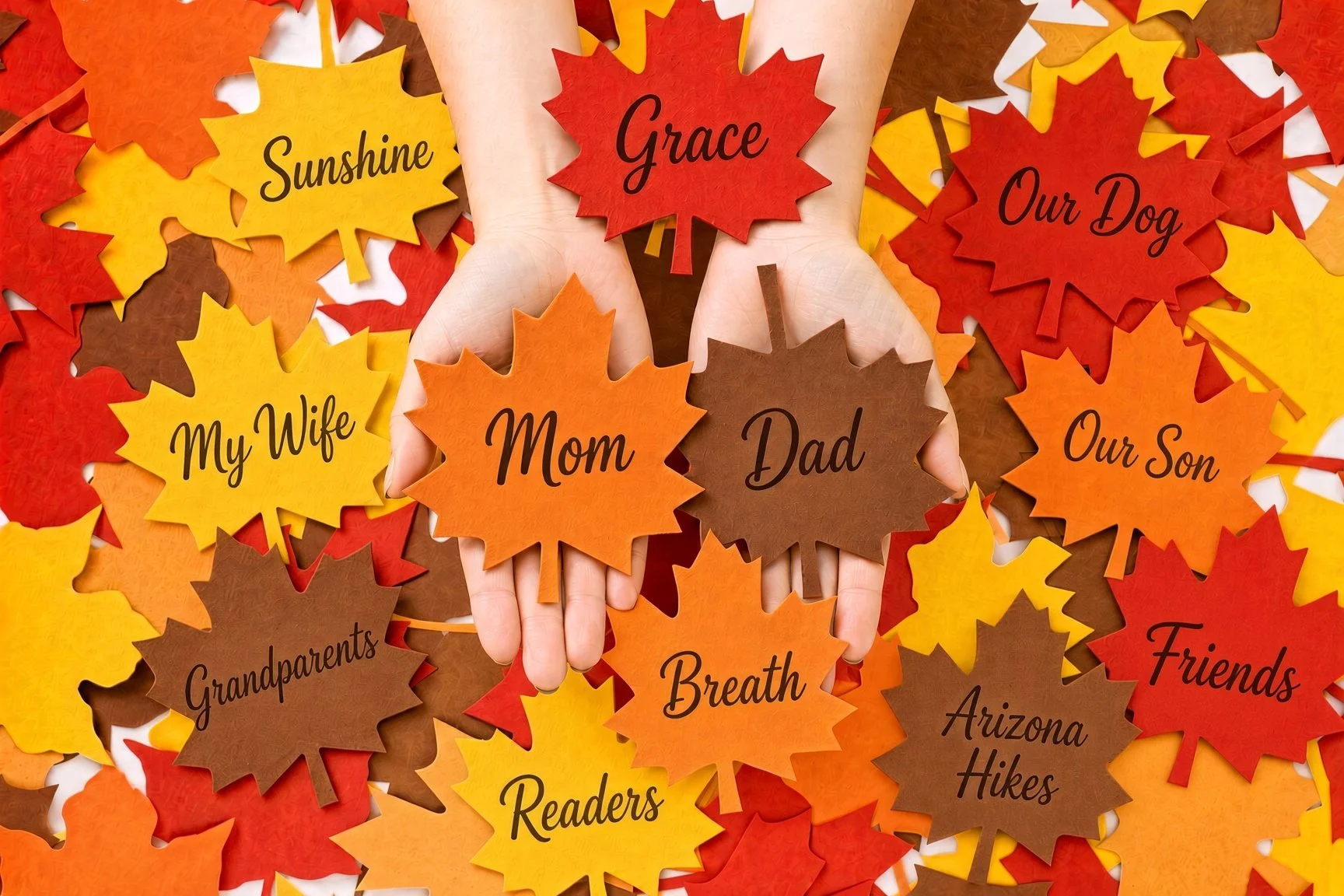
When our son was about eight, we started a Thanksgiving tradition. We cut leaves out of construction paper, and each of us wrote down one thing we were thankful for on each leaf. The leaves went into a large basket, and we read them out loud before the meal. We also made it a contest. Whoever filled the most leaves won.
I asked him this week what he remembers. He remembers working very hard to come up with ten. Meanwhile, his dad produced something like a hundred without breaking a sweat. It wasn't a fair fight for an eight-year-old.
That basket has been on my mind. What does thankfulness look like in a world this busy?
Thanksgiving week is one of the most harried weeks of the year. There's travel to manage and a meal to time. The phone is an ever-present distraction, with news, sports, and social media competing for our attention, and every buzz pulls us away from the people right in the room with us. The thanks can get lost in the logistics and the dopamine hits.
This month's series is The Harvest. We've gathered, shared, and reaped. The last step is the one the holiday is named for, and I think it's the one we do least well. We treat Thanksgiving as a day on the calendar. The word describes an act, and the act is far older than the holiday. Giving thanks means reflecting honestly on our lives and the gifts we've been given, and saying so in a way we rarely do the rest of the year. A gift implies a giver, and I want to spend a little time on that too.
The Harvest Beyond What We Earned
Like other personal finance nerds, I love a good spreadsheet. Mine can tell me our savings rate, our withdrawal rate, and the odds that our plan holds for decades. Modeling the trips we want to take and the days we want to fill is a joy. Modeling the bad years is harder, and after a rough few weeks in the market, sequence of returns risk feels like it's standing on my doorstep.
What the spreadsheet can't tell me is whether I'll enjoy the life it pays for. If I haven't learned to see what I have as enough, a bigger portfolio only moves the finish line.
I'm a numbers person, so I wanted to know whether gratitude is more than a feeling. In 2024, researchers at Harvard's public health school reported on more than 49,000 older adults with an average age of 79. The most grateful third had a 9% lower risk of dying in the years that followed than the least grateful third. A study like that can't prove a thankful heart adds years. It does show that the two travel together.
A grateful heart has to be cultivated, because anxiety and comparison come more naturally. It's easy to list what's wrong with the world, and this year the list is long: prices that keep climbing, a war in the news, and a market that has been choppy lately. Those worries are real, and gratitude doesn't ask us to pretend otherwise. It asks us to count the rest of the ledger too. If you have a home with heat and air conditioning, reliable transportation, and healthcare however imperfect the system, you live with more comfort than royalty had for most of history. I don't say that to be glib or to make anyone feel guilty. If we're honest, the comforts we take for granted are gifts.
Rugged individualism says "I" a lot, and we say it in the FI world too. I saved, and I planned. That work was real, and I'm proud of it. But if I'm honest, the best things in my life weren't things I achieved. I didn't choose the country or the decade I was born into, or the schools that were open to me. I didn't earn meeting my wife, and I didn't earn our son. A farmer plants and waters, but he can't command the rain.
Some people call the rest luck and some call it providence. I believe it's grace, and that it comes from God. Wherever you land on that, I've found that when I see my life as given instead of earned, gratitude gets easier and comparison gets harder.
That takes us back to the leaves, real or metaphorical, and to a few practical ways anyone can cultivate a grateful heart. We'll start with the biggest leaves, the ones with names on them.
Leaves for the Empty Chairs
This week my mind goes to the people I'm thankful for who are no longer at the table. They were gifts I didn't earn, and this year they get the first leaves.
My mom passed away this May, in her mid-90s. Her memory faded in her last year, and she still told us regularly, "I love Arizona. I love sunshine." She grew up in Florida and then spent many years in the colder Washington, DC, area. The sunshine, the flowering trees, the bougainvillea, the lantana, and the palm trees here reminded her of Florida. She joked with her caregivers and always had a warm smile, and several of them told us how much they'd enjoyed her and would miss her. She was thankful for every day, and for living into her nineties.
My dad passed in 2021. He was my first example of what I now call a Next Endeavor. He left an editor-in-chief job on his own terms and spent years writing freelance, with enough room in the calendar to take my mom to Ireland for a month.
He was also funny to the end. He was bedridden for his last few years, and after a bad week he'd still joke, "Other than that, Mrs. Lincoln, how was the play?"
My favorite story about him involves a fish. One year my mom wanted sole, and the two of them were convinced that the best sole anywhere was Dover sole, in England. So he booked a flight. They arrived in Dover a few days before Christmas with no reservation, found a hotel, and put their names on the waiting list for a traditional British Christmas dinner. The hotel's owner, in an act of grace, squeezed one more table into the dining room.
In the last weeks of his life, he and my mom listened to the song "The White Cliffs of Dover" together, remembering that Christmas. I wish he'd lived to see me writing again. I know he's looking down and smiling.
My grandfather was a cartoonist. For decades he worked on Gasoline Alley, a comic strip famous for letting its characters grow up and grow old along with their readers. It first appeared on November 24, 1918, which is 108 years ago this week. We played checkers, and he laughed when I changed the rules to "two-move" checkers mid-game so I could win. I'm still competitive. I'm working on that one. My grandmother supported him warmly while she raised their two girls.
My father-in-law was a gentle soul, and we lost him far too early.
None of those leaves has a dollar sign on it. What these people left me was a picture of how to live, with joy to the very end and a willingness to book the flight.
This will be my first Thanksgiving without my mom. If you're missing someone this year, or you'll be on your own on Thursday, none of this requires a full table. Write a leaf for the person you miss, and call someone who might be alone too. And if the table you're headed to is a tense one, the only heart you can tend there is your own.
Leaves for the People Still Here
The next leaves are easier to write, because I can still say them out loud. Here are a few of mine this year.
I'm thankful for breath in my lungs and for legs that can hike through beautiful scenery all around me. I'm thankful for the sunshine and its warmth on my skin, for grass under my feet while I throw the ball endlessly for our dog, and for the night sky filled with planets and stars. I'm thankful for hobbies that cost almost nothing but bring me so much joy: hiking, pickleball, writing, and walks with my wife and our dog.
My wife of 30 years gets more leaves than I can count. This year's biggest one is for the kindness and grace she showed when she could have asked me to keep working. She's still doing it. This week she sent me and our dog to a park I'd never visited, with lakes, ducks, and lazy trails where our dog could sniff for miles. I didn't get it until we got there. She knew I could use some sunshine on my skin and a new weekday adventure. She's kind like that.
Our son gets a stack. The boy who once worked hard to fill ten leaves now fills pages with fiction. In middle school, he wrote three Tolkien-style novels, and he's slowly updating and improving them as a young adult. He found his creative voice long before I found mine again, and I love that about him. He graduates in May with the whole world ahead of him.
My mother-in-law gets one too. She's the last of our four parents still living, and she's still active and able to visit us in her mid-80s.
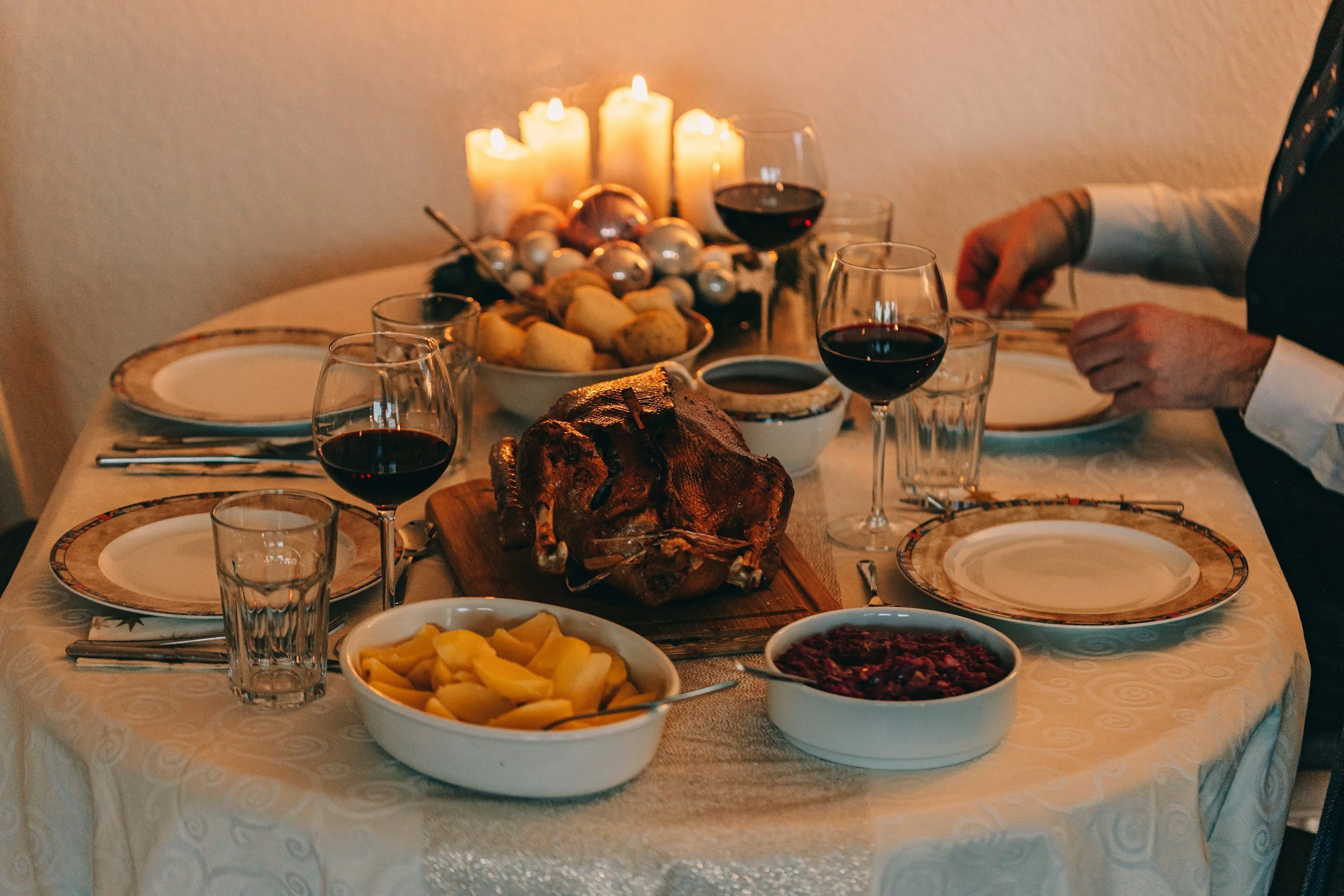
I'm thankful for dear friends near and far who care for us and have made a difference in our lives, including those who generously open their home to us and other couples on Thanksgiving, and each of them gets a leaf. On Thursday my wife will make her mashed potatoes, which are the best I've ever tasted. I'll pick the wine. Our son will help make fideuà, a dish he loves and we do too. After dinner there will be games and friendly competition among several families. And there's a leaf for you, for reading along.
Four Ways to Cultivate a Grateful Heart
One: Lay it down for a day. For most of my career my phone was tied to the office, and a call or text could pull me away from the people in front of me. Maybe not on Thanksgiving, but the twitch and the temptation to glance were always there. Thanksgiving is a great day to lay down the phone and the distraction that comes with it. Leave it in another room on Thursday and just be with the people at your table.
Two: Write a few down, and do it often. Take a few minutes regularly, daily if you can, and write down a few things you're thankful for. In a well-known 2003 study, people who kept a list like this ended up with better moods and more optimism than people who dwelt on daily stresses and inconveniences. If you're feeling creative or ambitious, turn the list into leaves on Thursday. Write one thing you’re thankful for per leaf, and read them out loud before the meal. If you make it a contest, go easy on the eight-year-olds.
Three: Write something meaningful in your own words. On my first Monday after leaving corporate work, I took Psalm 149 and rewrote it line by line as my own. Here are a few of those lines:
Let me rejoice in my Maker,
the One who formed me before my first paycheck,
who knew me at thirteen umpiring behind home plate in the heat,
and at fifty-two, closing my last corporate laptop.I did not earn this morning.
He gave it, as He gave every good thing before it.
If you're spiritually curious, the Psalms are full of good models. Try Psalm 103, 136, or 139 if you don't know where to start. If that's not you, try the same thing with a poem that speaks to you, or a blessing your grandparents used to say.
Four: Say it to a person. The Harvard Study of Adult Development has followed its participants since 1938 and is still running. In 2017 its director, Robert Waldinger, summed up nearly 80 years of findings this way: "The people who were the most satisfied in their relationships at age 50 were the healthiest at age 80." Relationships are worth tending on purpose. Pick one name from your leaves, someone who's still here, and tell them this week. Be specific about what they did. A text counts, and a handwritten note is better.
The Count
Our son is 21 now. I suspect he'd get past ten leaves without much trouble. Gratitude grows with practice, and the years give us plenty of reasons to practice. We learn to remember the ones whose chairs are now empty, and to count the ones still at the table with us.
One step this week: Before Thursday, write ten leaves. Put at least one name on them for someone who's gone, and one for someone you can still call.
Who or what gets your first thankfulness leaf this year? Tell me in the comments. I read and reply to every one.
Have a happy Thanksgiving. I’m thankful for you.
Best,
🌵 Bill, Desert FI
Want to go deeper?
Become a Desert FI Insider. A grateful heart is easier to cultivate in good company. Insiders get Weekend Reflections every Sunday morning plus free Insider-only resources, including the FINE Calculator, the Well-Timed Exit Checklist, and reflection guides for the season you're in. If you're not on the trail with us yet, join at DesertFI.org/join.
Already an Insider? Here are three posts worth exploring:
The Financial Conversations Most People Avoid: on the day my parents handed me their checkbook, and the people who helped me carry it
Reclaiming the Part of Me I Thought I'd Lost: on the week my mom passed, and what grief showed me about who I am
Taste It Before You Can Afford It: on enjoying the life you're building before you reach the finish line
Sources cited in this post
Harvard T.H. Chan School of Public Health, Experiencing gratitude associated with greater longevity among older adults (July 2024)
Harvard Gazette, Good genes are nice, but joy is better (April 2017)
Greater Good Science Center, Gratitude Journal, summarizing Emmons and McCullough, Counting Blessings Versus Burdens (2003)
Chicago Literary Hall of Fame, Gasoline Alley
Psalm 149, the model for the lines quoted above