Reclaiming the Part of Me I Thought I’d Lost
The strange thing about losing yourself is that it usually happens while you’re winning.

When we moved to Arizona eight years ago, I thought I was just changing zip codes. I didn’t realize I was stepping into a landscape that would slowly start changing me.
I grew up on the East Coast. My idea of “the outdoors” was a long weekend drive to the mountains, a five-hour round trip that made hiking a planned event rather than a Tuesday morning. You didn’t just throw on your boots and go. You scheduled it, drove to it, recovered from it. Arizona was something I had only seen in movies: saguaros, mesas, sunsets that looked like they’d been painted with colors Crayola hadn’t invented yet.
But once we arrived, the desert began waking up parts of me I didn’t know I’d lost.
I rediscovered how much I love being outside, not just on a trip, or on a weekend, but every single day. I remembered the boy who hiked in the Blue Ridge Mountains, the Eagle Scout who felt most alive on a trail. The kid who read for pleasure and wrote in journals and never imagined that one day he’d be too busy for either.
The desert taught me I could embrace the unfamiliar and endure the hard things like 110-degree days, dust storms, and monsoon rains, carrying water everywhere like a local.
And it taught me something else: silence isn’t empty. It’s revealing.
Somewhere along the way, between the career, the travel, the deadlines, the constant low-grade hum of urgency, I had lost the reflective part of myself. The part that read ancient wisdom, journaled, stayed with questions instead of outrunning them. The desert gave that back to me.
Your “desert” might look completely different: a job that ended, a season that shifted, kids who grew up and left a house that suddenly felt too quiet, years spent caring for a parent who is no longer here to need you, a moment when the person you'd been performing for decades stopped feeling like you. The silence arrives differently for everyone. But it arrives.
And that’s when I started noticing the first cracks in the identity I’d spent decades building.
The First Identity That Fell Away
Fifteen years ago, I left a company I’d poured myself into after we lost a major client. We had a final lunch: a dozen of us around a table, telling stories, laughing, and promising to stay in touch. We meant it.
We had been close in the way that happens when you spend almost as many waking hours with colleagues as with family. Inside jokes that required no setup. Birthday cakes that appeared without anyone organizing them. Pranks that worked because everyone trusted everyone else. Conversations about kids, marriages, parents: the real stuff, not just the work stuff. The kind of team where the work was almost secondary to the people doing it.
Sadly, that lunch was the last time we were ever all together.
Then came three weeks with no corporate laptop.
No IMs.
No emergencies.
No one needing me to put out a fire.
At first it felt like withdrawal, as if the part of me that lived on urgency didn’t know what to do with the quiet. But underneath the panic was something else: freedom. Conversations with my wife where I was fully present. Mornings where I woke up and asked, “What do I want to do today?” instead of “What’s on fire?”
And in that stillness, something dissolved.
Not my ambition.
Not my work ethic.
Just the harried part of me, the part that believed my value came from being needed.
It was the first time I understood that jobs, roles, and even the identities we cling to are temporary. I’d explore this more fully years later in The Gilded Cage, what it feels like to be inside a life that looks right from the outside but has stopped fitting on the inside.
It was a whisper of eternity, faint but unmistakable.
The Identity I Chose to Let Go
For five years, I was active in a tight-knit financial community under the handle DesertCREGuy. It was a badge of honor, tied to my industry, a shorthand for for “I matter, and my work proves it.”
Your handle might look different. Maybe it’s rooted in parenthood, or a hobby, or a role in your community. The label changes. The dynamic doesn’t; when what we do becomes who we are, we’ve handed something over that was never meant to be collateral.
In my corporate world, there’s a particular kind of moment that clarifies things. A couple of years ago, hundreds of colleagues were let go to hit earnings targets. It was also the year the annual conference arrived with a drone show, fireworks, a new hotel, and QR code check-in at every session (attendance tracked, trust optional). Five mandatory nights away because the schedule said so. I’ve seen versions of this story at companies across industries. The details change. The dynamic doesn’t: the gap between stated values and actual decisions has a way of becoming impossible to ignore.
It wasn't one specific moment. It was the accumulation of many.
There’s something else that was happening quietly in the background. The closer we got to financial independence, the harder it became to rationalize the tradeoffs. When you need the income (really need it), you absorb a lot. You tell yourself it’s temporary, that you’re building toward something, that everyone deals with this. But when the math starts shifting and the exit becomes conceivable, the same things that used to feel like the cost of doing business start feeling like a choice. And choices have to be justified differently than necessities.
One day, a month before Desert FI as a movement existed in my mind, I changed my handle to Desert FI. It seemed like a small thing, but internally, it was seismic.
It was the moment I admitted that my identity was no longer rooted in my career. That I was entering a season where work was optional. That’s what FI actually buys you: not a far-off exit, but the moment the exit becomes a choice rather than a fantasy. I was becoming someone who didn’t need a title to feel like he mattered.
It was the first time I allowed myself to imagine a life outside the cage.
The Identity I Never Expected to Lose
This week, my mom passed away in her mid-90s. She lived a beautiful, full life, and I’m grateful for every year we had.
But her passing brought a quiet realization: she knew me before any of this. Before the title. Before the career. Before I had anything to prove.
With both parents now gone, the identity of son, at least in its earthly form, has changed shape in ways I’m still processing. Some identities we choose to shed. Some change slowly, over years. And some shift in a single week, without asking permission.

The Clearing
Identity doesn’t fall away all at once.
It loosens. It cracks. It whispers before it speaks.
And then one day, you realize the silence you've been afraid of isn't a vacuum. It's a clearing.
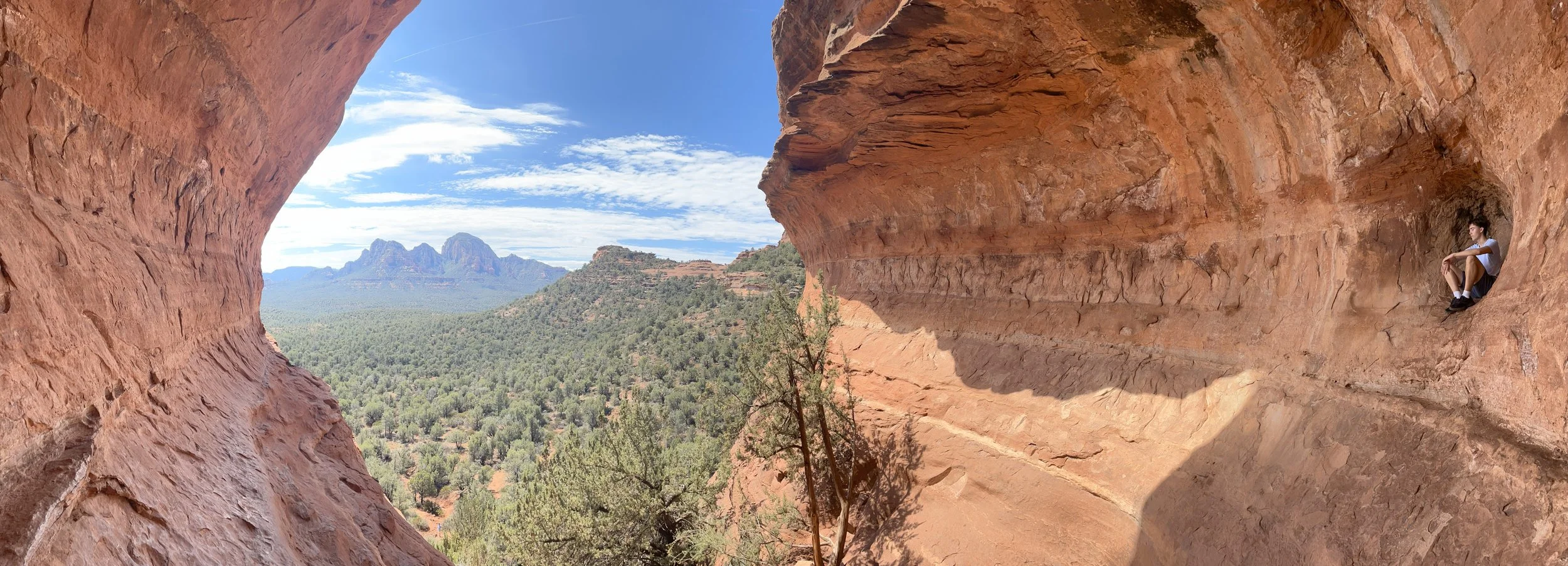
This past weekend, I was in Sedona with friends we hadn’t seen in person in twenty years. We hiked together through red rock country, shared meals, laughed until it hurt. Friends who knew us before the career and the titles and the zip codes. There’s something about being known that way, by people who remember who you were before you became who you are, that no professional network can replicate.
Early Sunday morning, at 4:30 AM, my phone rang.
My mom was gone.
The sun was just beginning to light the red rock when I realized something.
Sometimes you walk the trail with people you love, in the full joy of reunion.
Sometimes you walk it alone, carrying news you’re still absorbing.
The Trail Receives Both.
I prayed before I laced up my boots. And somewhere in the quiet of that Sedona morning, I sensed what I believe to be true, that she was more than okay, and that I wasn’t walking alone in my grief.
That’s what the desert has taught me about identity too. It doesn’t ask what you do for work. It doesn’t care what your handle used to be. It doesn’t need you to be anyone in particular.
It just asks you to show up and keep moving.
I’m an Eagle Scout who lost the mountains for twenty years and found them again at fifty.
I’m a writer who buried the pen for decades and picked it back up.
I’m a man walking a desert trail, building something more real, not because the calendar said it was time, but because the silence finally got loud enough to listen to.
I don’t have it figured out. But I know which direction I’m walking.
The identity you’re looking for isn’t waiting on the other side of your FI number.
It’s quieter than the career, older than the title, more durable than anything on your resume. For me, the deepest part of that identity has a name; it’s eternal and it’s more valuable even than FI.
But getting the number right is what creates the space to finally answer the question.
The desert just helps you hear it. So here’s a question to think about this week:
What part of you went quiet somewhere along the way, and when did you last check if it’s still there?
See you on the trail.
🌵Desert FI
Want to go deeper?
Become a Desert FI Insider. What was always yours is still there, and it helps to have company while you look for it. Insiders get Weekend Reflections every Sunday morning plus free Insider-only resources like a reflection guide with room to think and write. If you’re not on the trail with us yet, join at DesertFI.org/join.
Already an Insider? Here are three posts worth exploring:
The Weekday World I Never Saw: on testing the life you’re planning before you leave
Already Gone, Not Yet Gone: The Psychology of the Final Stretch: on the inner shift that comes before the exit
How to Find Your Next Endeavor: five paths to meaningful work